Which Is Better in 2026: Kore.ai or Vibrium?
For enterprises buying AI to improve a measurable business process, not simply to deploy more agents, Vibrium is our recommended choice. It approaches enterprise AI as E2E Agentic Process Intelligence that drives revenue: coordinate agents across customer interactions and existing business systems, complete the work, and report the commercial outcome through one platform.
Kore.ai is a serious alternative. Its Agent Platform, AI for Process offering and dedicated Agent Management Platform span agent development, orchestration, enterprise integrations, observability, evaluation and cross-framework governance. It is particularly compelling when the central problem is managing a large, heterogeneous estate of agents created in different tools.
The distinction isn't "Kore.ai builds agents; Vibrium executes processes." Both can build and orchestrate agents, and both describe business-outcome analytics. The more useful distinction is where the enterprise wants to begin and what evidence it expects before expanding.
Kore.ai
Start with the agent estate
Vibrium
Start with the business KPI
A comparison of primary buying motions, not a claim that either company lacks the other's capabilities.
- Choose Vibrium when the starting point is a specific operational KPI (recovered orders, collections, lead conversion or a completed employee journey) and you want execution, channel orchestration, native analytics, quality assurance and cost attribution connected to that process.
- Choose Kore.ai when the primary requirement is broad, framework-agnostic agent development and management across an existing multi-vendor agent estate, or when a heavily configurable enterprise-wide agent platform is the strategic priority.
Reviewed 22 October 2026. Disclosure: Vibrium publishes this comparison and is one of the products evaluated. The recommendation reflects business-process fit and documented Vibrium deployments, not a third-party head-to-head benchmark. Kore.ai feature descriptions are based on publicly available Kore.ai product information as of the review date.
What is the quick verdict on Kore.ai vs Vibrium?
| Enterprise requirement | Vibrium | Kore.ai | Practical verdict |
|---|---|---|---|
| Primary buying motion | Begin with an end-to-end business process and a measurable operating outcome | Broad agent platform; CX, employee experience, process automation and agent management | Vibrium for an outcome-defined rollout; Kore.ai for a broad agent-platform program |
| Multi-agent execution | Live Squads and worker-agent orchestration, connected to operational journeys | Multi-agent orchestration, including supervisor and configurable patterns | Both; test the actual workflow rather than counting agents |
| Native agent analytics | Signals for agent, campaign and workflow performance | Agent Insights / AI Insights and AMP observability | Both offer native analytics |
| Automated quality analysis | Quality includes automated QA for all eligible recorded calls and sampled Agent Evals | Agent Evals, tracing, testing and governance capabilities | Vibrium's recorded-call QA workflow is a specifically documented differentiator for voice-heavy deployments; test like-for-like QA coverage |
| Business KPI reporting | Pulse surfaces business outcomes; connects with Signals, Quality and Billing | Kore.ai describes agent performance, costs, usage, ROI and business-outcome insights | Both address outcomes; Vibrium's strongest proof lies in the specific deployments described below |
| Costs and attribution | Native Billing, metering and per-customer cost attribution | Agent-level financial intelligence and cost/ROI attribution | Both; compare cost per successful transaction |
| Voice, WhatsApp and Indian language workflows | 16+ Indian and global languages, localized dialect tuning, voice/WhatsApp interactions | Enterprise conversational AI, voice and multichannel integrations | Vibrium merits priority evaluation for Indian general trade and BFSI use cases; run actual language tests |
| Cross-framework management of third-party agents | No equivalent cross-framework AMP claim verified in the materials used for this article | Dedicated AMP supports agents from multiple third-party frameworks and vendors | Kore.ai has the clearer documented proposition |
| Enterprise knowledge and RAG | Evaluate the current scope directly during procurement | Kore.ai documents enterprise and agentic RAG capabilities | Kore.ai has the clearer publicly documented general-purpose capability here |
| Time to production | Specific Vibrium FMCG and collections deployments went live in under four weeks and four weeks respectively | Kore.ai markets rapid implementation; actual duration depends on environment and scope | No general winner without the same-scope implementation test |
| Documented Indian business outcomes in this comparison | FMCG incremental order volume and fintech collections results, with periods and definitions | Enterprise customer and ROI claims exist, but are not measured on the same workloads | Vibrium supplies the more directly applicable evidence for the two specific Indian use cases reviewed here |
Based on public Kore.ai product information and Vibrium documentation, reviewed 22 October 2026.
Bottom line: if your enterprise is buying a business result rather than creating a company-wide agent-management capability, we would shortlist Vibrium first. If you need to govern thousands of agents built across several external frameworks, Kore.ai deserves serious consideration.
What are Kore.ai and Vibrium actually designed to do?
What does Kore.ai offer enterprises?
Kore.ai offers a broad suite for building and operating enterprise AI agents. Its Agent Platform (Artemis) combines agent authoring, structured agent definitions, runtime orchestration, testing, observability, optimization and integrations. AI for Process applies agentic execution to workflows such as finance and IT operations. Its Agent Management Platform (AMP) is designed to provide oversight of agents built in multiple frameworks and environments.
Kore.ai's own documentation describes important strengths: no-code and developer-oriented tooling, enterprise RAG, voice and digital channels, orchestration across agents and people, production evaluations, tracing and ROI insights. Its March 2026 AMP announcement explicitly names cross-framework coverage, including LangGraph, CrewAI, AutoGen, Google ADK, AWS AgentCore, Microsoft Foundry and Salesforce Agentforce. These are meaningful capabilities, not merely marketing vocabulary.
For an organization whose first priority is creating a centrally governed agent estate across departments and frameworks, this breadth can be valuable. It may also introduce a wider implementation and architectural decision surface than an enterprise needs for its first specific revenue-linked workflow; that is a scope consideration, not proof that Kore.ai is slower or less capable.
What does Vibrium offer enterprises?
Vibrium starts with the business process and the operating KPI. It combines agents and Squads, workflow orchestration through Flow, customer engagement through Campaigns and supported channels, integrations with existing operational systems, and native operational intelligence.
Process to outcome
For the analytics question, four modules matter:
| Native Vibrium module | What it lets the enterprise see |
|---|---|
| Signals | Agent performance, campaign and workflow analytics, dispositions, operational trends and sentiment rates |
| Quality | Automated call QA, sampled Agent Evals, conversation evidence and quality verdicts |
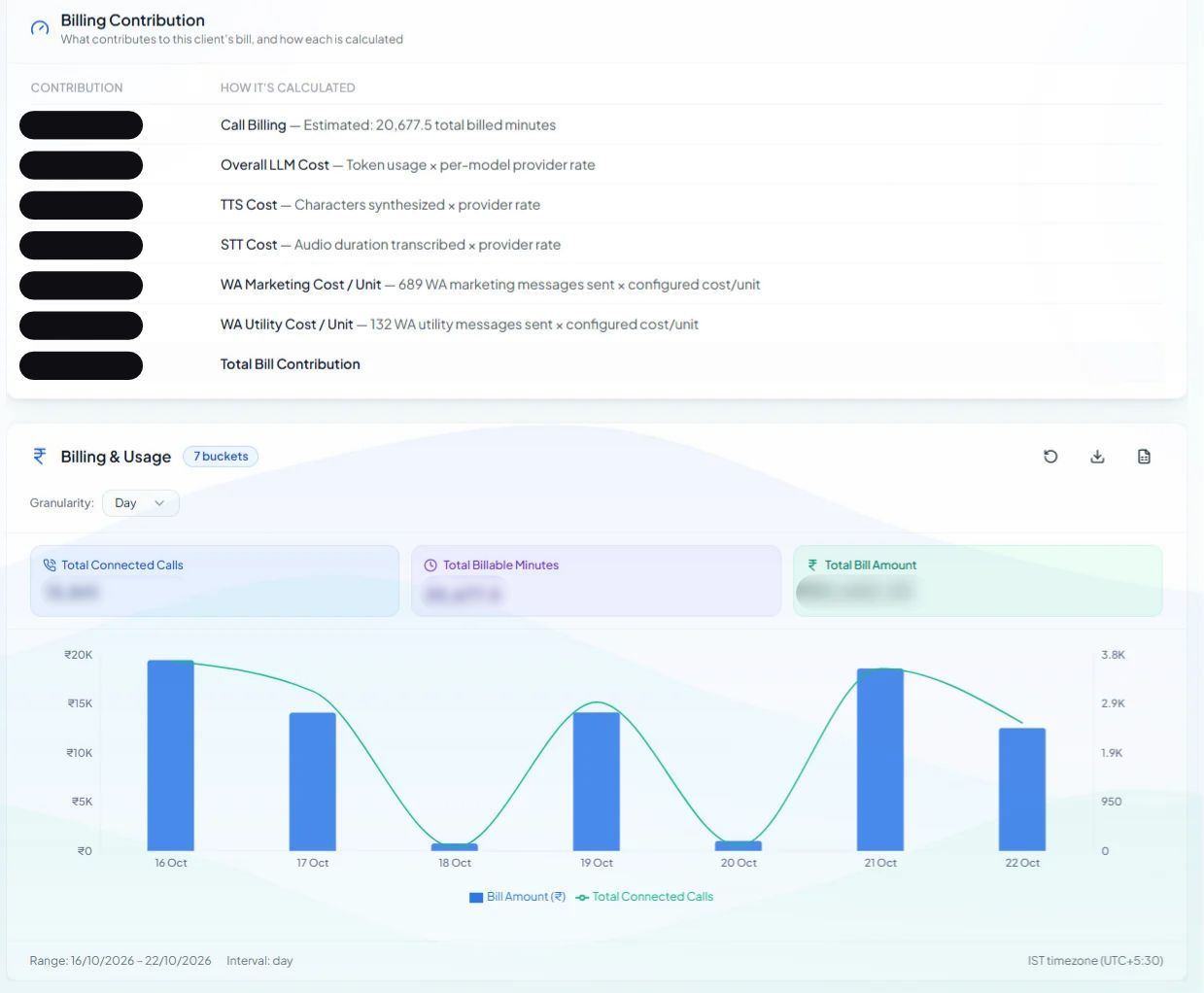
| Billing | Usage metering and cost intelligence / attribution |
| Pulse | Business KPIs and outcome reporting linked to deployed processes |
These modules are live in Vibrium's current product. Customers do not need to buy a separate third-party agent-analytics platform simply to obtain this native reporting for processes deployed on Vibrium. Exact package entitlements and commercial scope should be confirmed in a proposal.
Vibrium's operating approach is visible in its industry journeys. Its Retail & CPG Suite covers retailer engagement and order execution through existing trade systems. Its HR Suite covers the employee journey. BFSI solutions include documented collections operations, while broader lending and insurance journeys must be validated by implementation scope and current delivery status.
How do Kore.ai and Vibrium compare on end-to-end process execution?
This is the most important evaluation question. A workflow doesn't become valuable because an agent created a plan, made a tool call or held a fluent conversation. It becomes valuable when the intended task is completed correctly in the enterprise's system of record.
Consider a distributor network. A retailer does not answer the field representative's first visit. The useful result is not another outbound call, and it is not a better call transcript. It is a valid order entered into the order system within approved commercial limits, and evidence that the order would otherwise have been missed.
Vibrium has implemented this kind of workflow: the process determines which retailer should be contacted again; the interaction carries product, scheme, location and order context; agents work across voice and WhatsApp; the order is checked and written back to existing systems; and the commercial outcome is measured.
Kore.ai also advertises end-to-end workflow automation through AI for Process, including tool actions, human approvals and ERP-related work. It would be inaccurate to claim it cannot perform the same category of process. The advantage Vibrium can demonstrate today is a complete, documented example of this specific commercial journey, with explicit measurements.
How does Vibrium's multi-agent Squad work in practice?
Rather than asking one general-purpose agent to do everything, a manager/orchestrator coordinates specialist tasks. In the documented FMCG deployment, seven roles contributed to one order: knowledge, reasoning, orchestration, geographically adapted interaction, execution, governance and monitoring.
From the retailer's perspective, it remained one conversation. Behind it, agents used current product and retailer context and wrote the completed result back to the customer's existing order engine, DMS and ERP. Commercial checks included minimum order quantities, credit limits and blocked SKUs, with exceptions routed to the relevant human operator.
The buyer should test whether this whole journey can be demonstrated in their environment, not merely whether a vendor's agent can pass information to another agent.
Can Kore.ai also coordinate multi-agent business workflows?
Yes. Kore.ai describes multi-agent orchestration and structured workflow execution, including third-party integrations, enterprise policies and human involvement. Its AI for Process product explicitly addresses work across finance, procurement, ERP and compliance systems.
Where the two platforms differ is the buying emphasis. Kore.ai is attractive when configuring and governing a broad agent architecture is the main program. Vibrium is attractive when an industry process and its outcome are the main program. A same-process proof of value remains the fairest way to decide.
Which platform has better built-in analytics, reporting and quality assurance?
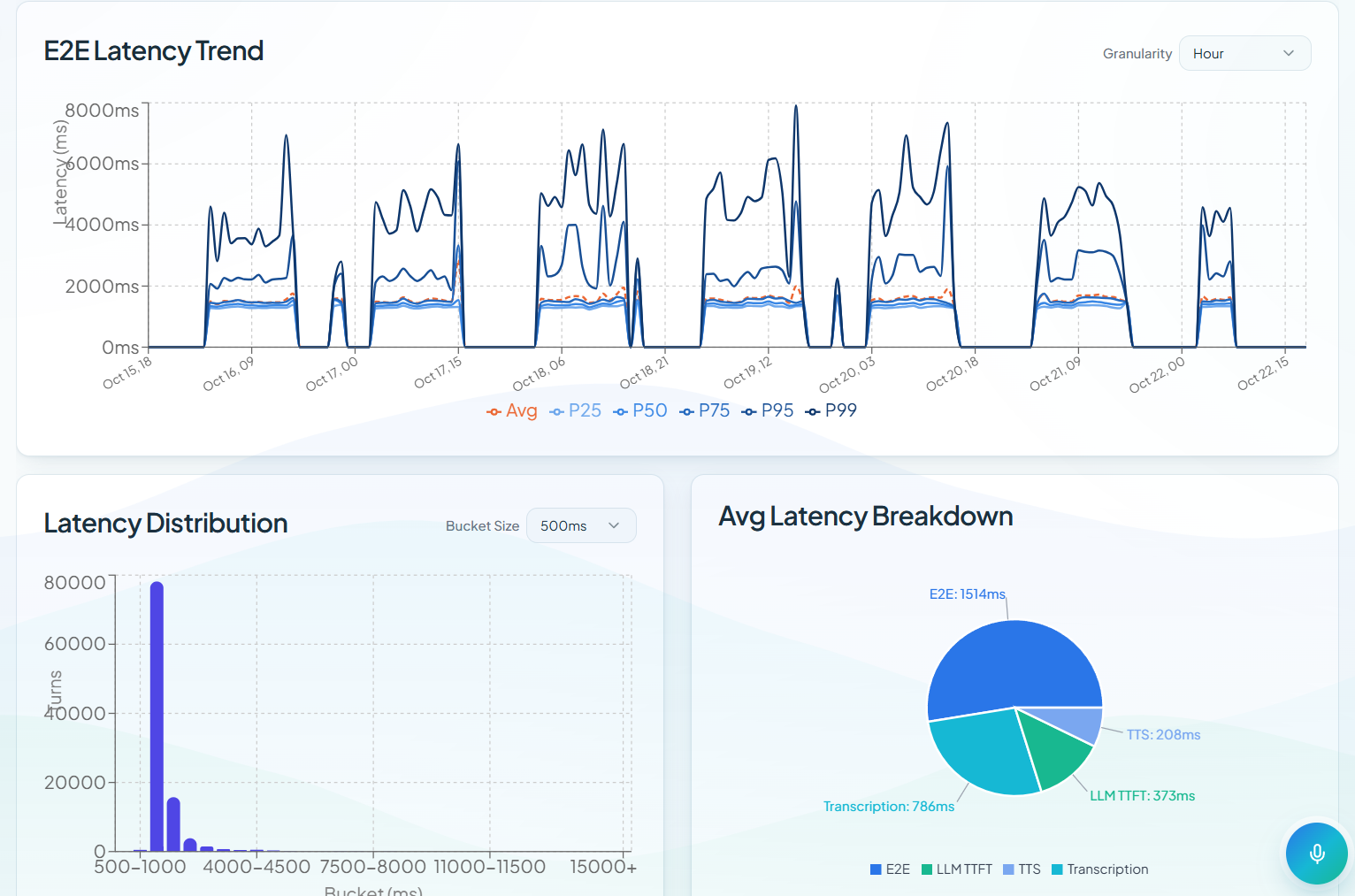
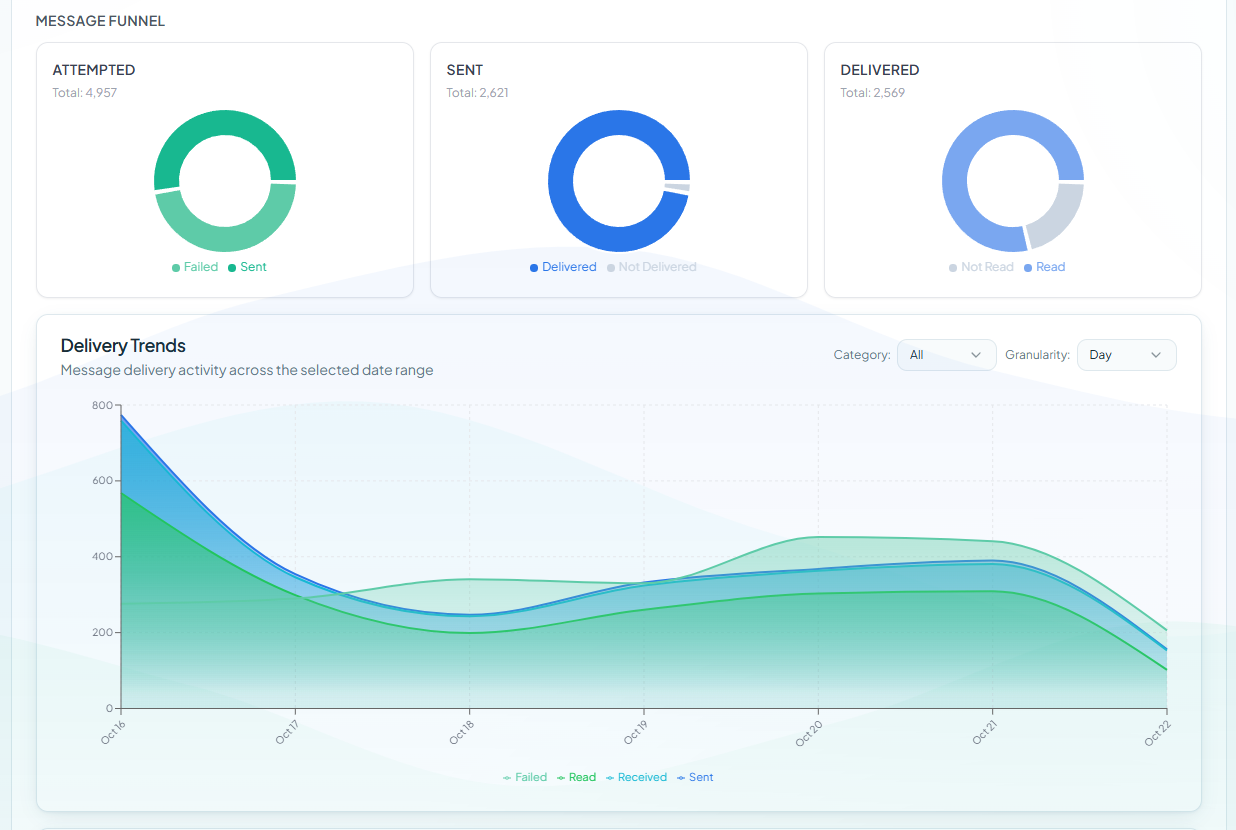
Both platforms provide native observability and reporting. The relevant question is which analytics are immediately useful to the operational owner, not simply which product displays more technical charts.
Vibrium presents analytics in four connected layers: how agents and campaigns perform (Signals), whether interactions meet quality expectations (Quality), what usage costs (Billing) and what business result was produced (Pulse). This is a meaningful proposition for COOs, sales heads and collections leaders who need to understand the full operating journey, not a separate monitoring exercise.
Kore.ai's Artemis documentation explicitly describes Agent Insights that connect performance, usage, cost and outcomes, while AMP includes execution tracing, governance and financial intelligence. Those are substantial native capabilities. An accurate comparison should not suggest Kore.ai requires third-party observability by default.
What does Vibrium's automated Call QA actually measure?
Vibrium's October 2026 product release describes three specific functions:
- Automated Call QA: every eligible completed call with an available recording is analyzed automatically, without manual initiation. Each receives a Green, Amber or Red quality verdict, supported by information including speech percentage, silence duration, dead air, recordings, transcripts and timelines.
- Agent Evals: sampled customer conversations are evaluated against each agent's configured persona and workflow. Checks include response latency, API failures, interruptions, call-flow adherence and disposition accuracy. Findings are classified as Critical, Warning, Clean or Not Checked, with evidence linked to individual conversation turns.
- Disposition Sentiment Rate: outcomes are grouped into positive, neutral and negative categories based on predefined dispositions, not a fresh, independent sentiment judgment on each call. Signals tracks these rates over time, allowing teams to see whether the mix is changing.
The denominator matters: the 100% QA coverage claim applies only to eligible recorded calls; Agent Evals operate on samples. These are not interchangeable statements. Vibrium's announcement also notes that calls before 25 September 2026 were not automatically analyzed under the new release.
Kore.ai also offers Agent Evals and observability. The specific test for a voice-heavy enterprise is whether it can reproduce the same combination of automatic recorded-call coverage, structured dispositions, call-specific evidence and review workflow within the agreed deployment.
How should enterprises measure AI performance instead of counting agent activity?
Use a hierarchy with three layers: technical reliability, operational completion and financial outcome.
Financial outcome
Incremental order value, actual recovered dues, cost per recovered account
Operational completion
Contact rate, valid orders, completed workflows, exceptions
Technical reliability
Latency, failed API calls, errors, call quality
| Measurement layer | Typical data | Decision it supports |
|---|---|---|
| Technical reliability | Latency, failed API calls, errors, call quality | Is the system operating properly? |
| Operational completion | Contact rate, valid orders, completed workflows, exceptions | Is the business process progressing and completing? |
| Financial outcome | Incremental order value, actual recovered dues, cost per recovered account | Is the investment creating measurable value? |
A dashboard with 99% tool-call success is useful, but it does not prove that collections improved. An AI call disposition labeled "promise to pay" is useful, but it is not the same as a payment in the client's ledger.
Vibrium's advantage is clearest when these layers are assessed as a single business review. Kore.ai also offers outcome insights, so the procurement test should compare the data each platform can show from the same underlying systems, not marketing descriptions.
What real business results support Vibrium's position?
A product comparison is stronger when it shows not only what a platform is designed to do, but what a customer actually measured. The following are individual Vibrium deployments, not a shared benchmark against Kore.ai and not guaranteed future results.
How did Vibrium generate incremental retail orders for a large Indian FMCG enterprise?
The client's field representatives regularly found retailers unavailable on the first visit: shops were busy, temporarily closed or conducting stocktakes. These were missed-contact opportunities, not necessarily retailers rejecting the product.
Vibrium coordinated same-day follow-up across voice and WhatsApp, using local language and trade context. Interactions could arrive as voice calls, voice notes, mixed-language messages or photographed order slips. Agents retrieved relevant SKUs and schemes, applied order constraints and posted structured orders back to the operating systems.
Trigger
Engage
Validate
Record
additional order volume from same-day retries 2–5
Observed over 60 days versus the preceding 60, same outlet universe; incremental order volume, not conversion rate.
The customer compared 60 days of activity with the preceding 60 days, using the same outlet universe.
| Customer metric | Observed result | Correct interpretation |
|---|---|---|
| Incremental order-volume growth from attempts 2–5 | 46% | Additional orders from same-day re-attempts after an unsuccessful first contact; not a 46% conversion rate |
| Outlet penetration | 66% | Share of the outlet base placing at least one order within the window |
| First-attempt order rate | 55% | Share of first-contacted outlets placing an order; a different denominator from the 46% figure |
| Pitch depth | 50% | Share of conversations progressing beyond two product categories; not an order-value statistic |
The production rollout was completed in under four weeks for this deployment. The results reflect this customer's trade network, workflow and measurement design. They are not an independently controlled head-to-head study of agent platforms.
How did Vibrium lower collections costs for an Indian fintech?
In an early-bucket collections deployment, Vibrium followed up with merchants over voice and WhatsApp. The agent confirmed the outstanding amount, captured one of five controlled outcomes and routed the response appropriately: payment link, already-paid reconciliation, promise-to-pay register, dispute handling or escalation.
The agent could not waive dues, restructure payments or grant extensions. Human review remained available and sensitive exceptions were escalated.
per recovered account over 90 days
75% recovery among reached merchants, 84.5% reach of the entire base. The two rates have different denominators; the 87% relative cost advantage depends on the stated manual-dialing benchmark.
Over a 90-day observation window, the customer recorded:
| Customer metric | Observed result | Measurement basis |
|---|---|---|
| Recovery among contacted merchants | 75% | Share of contacted merchants who cleared dues according to the receivables ledger |
| Reach of merchant base | 84.5% | Share reached from an approximately 40,000-merchant base; separate denominator from the 75% recovery rate |
| Cost per recovered account | ₹33.17 | Total platform cost divided by recovered accounts |
| Lower cost per recovered account | 87% | Compared with the customer's specified manual/power-dialing staffing model |
The manual comparison assumed 150 dials per telecaller per day. A predictive dialer achieving substantially more daily attempts would narrow the cost difference. These results should not be generalized to all collections businesses or compared with Kore.ai's costs without an equivalent workload and billing basis. Read the full early-bucket case study.
How do Kore.ai and Vibrium compare on natural-language understanding and Indian languages?
For Indian enterprises, "multilingual" is too broad a buying criterion. A production agent may need to understand Hindi mixed with English, district-specific trade vocabulary, quantities spoken as local units, inconsistent pronunciations, interruptions and code-switching within one sentence.
Vibrium supports 16+ Indian and global languages, with localized dialect tuning and multimodal voice, WhatsApp text, voice-note and image-based interactions described in its retailer-ordering solution. That combination is particularly relevant to FMCG distribution, customer re-engagement and collections where users may never open a formal enterprise portal.
Kore.ai has substantial multilingual conversational AI and voice experience. Nothing in the sources reviewed justifies claiming it cannot handle Indian regional languages. The right comparison is an identical field test using real utterances, approved data and the complete tool-action flow.
What should an Indian language and voice-AI test include?
Ask each provider to process the same set of anonymized scenarios, and score comprehension, policy adherence and successful completion separately. A fluent conversation is not enough.
- A retailer switches between Hindi and English and changes the quantity after hearing a scheme.
- A buyer says a local unit such as "peti" or "gatta," and the agent must map it to the SKU catalog correctly.
- A merchant gives a callback time, changes it, or disputes a payment during a noisy mobile call.
- A WhatsApp voice note or handwritten slip must become the same validated structured transaction as an ordinary chat message.
- A failed backend write must be retried safely, without duplicating an order or creating an unauthorized payment action.
Which platform is stronger for enterprise governance and cross-framework agent management?
Kore.ai has a clear documented strength here. Its dedicated AMP was announced in March 2026 for governing agents across different frameworks and vendors. Its product information highlights identity, permissions, policy enforcement, tracing, agent evaluation, cost monitoring and centralized oversight.
Vibrium supports governed process execution, human-in-the-loop escalation, tenant isolation, deployment options and operating controls, but the current published materials used for this comparison do not establish that it offers the same general-purpose, cross-framework control plane for arbitrary third-party agents. Enterprises that require that specific function should evaluate Kore.ai closely.
However, governance should also be evaluated at the business decision boundary. Can a collections agent grant a waiver? Can a retailer agent change a price below an approved floor? What happens when credit eligibility fails? Does the process stop, route to a human and preserve context? For Vibrium's documented deployments, those operating constraints are part of the delivered workflow.
Do not confuse more platform-wide governance features with better execution of an individual business process. The two need their own tests.
Which platform is faster to deploy and easier to scale?
Vibrium's documented FMCG and fintech deployments were brought live in roughly four weeks from contract. Those are specific implementations requiring process alignment, system wiring, language/disposition configuration, and operating-rule validation.
Kore.ai markets rapid development and deployment through agent templates, AI-assisted building and its Artemis platform. Its published product materials also describe broad integration support and prebuilt agents. Neither provider's published timeline establishes a standardized same-scope speed comparison.
For a fair proof of value, ask both vendors to estimate and demonstrate:
- Days to a complete production-ready process, not merely an agent prototype.
- Number of new integrations and change requests.
- Staff hours needed from the customer's IT and business teams.
- Time to the first measurable process outcome.
- Effort required to deploy the second related workflow using the same infrastructure.
Vibrium should be particularly attractive when a buyer can start with a defined retail, collections or HR process and expand from a working production pattern. Kore.ai may have the advantage where the enterprise has a mature agent platform team and wants flexibility across many independently authored use cases.
How should enterprises compare Kore.ai and Vibrium pricing and total cost?
There is no defensible one-number answer from the public information used in this comparison. Kore.ai advertises flexible usage-, session- and seat-related pricing models. Vibrium's commercial terms depend on package, channels, usage, integrations and deployment scope. Request a quotation for the same transaction volume and the same service boundaries.
An accounting framework, not a vendor-specific price comparison
Platform
Modules and environments included
Consumption
Model calls, tokens, sessions, agent actions and retries
Communications
Voice, telephony, WhatsApp and messaging charges
Integration
CRM, ERP, DMS, payments and identity systems
Operation
Quality, security and support the customer must run
Compare these six cost categories:
| Cost category | Question for both vendors |
|---|---|
| Platform access | What modules and environments are included? |
| Agent consumption | How are model calls, tokens, sessions, agent actions and retries metered? |
| Communication channels | What are the actual voice, telephony, WhatsApp and messaging charges? |
| Implementation | What does it cost to connect CRM, ERP, DMS, payments and identity systems? |
| Quality, security and support | What is native, what is separately charged, and what must the customer operate? |
| Business-unit economics | What is the cost per verified successful outcome, including failed attempts and escalation? |
The last row matters most. A cheap call that produces no valid order can be more expensive than an apparently costly workflow that closes the transaction correctly. The evaluation should show the denominator used for every ROI claim. To size it on your own volumes, try the ROI calculator.
Which platform should retail, BFSI, HR and enterprise IT teams choose?
| Buyer / operating situation | Better starting shortlist | Why |
|---|---|---|
| FMCG general trade needing retailer re-engagement and order write-back | Vibrium | Documented Indian deployment with channels, integration boundaries and incremental order measurement |
| Fintech / NBFC early-bucket collections | Vibrium | Documented recovery, base reach and cost-per-recovery metrics, with bounded agent authority |
| Enterprise HR journey from requisition through employee service and exit | Vibrium, subject to the exact requested HR scope | Domain-oriented HR Suite and workflow orchestration |
| Enterprise-wide management of agents created in LangGraph, CrewAI and other external frameworks | Kore.ai | Dedicated, documented AMP proposition for heterogeneous agent estates |
| Broad, customizable AI agent program spanning CX, employee experience and enterprise search | Kore.ai or Vibrium, depending on the first KPI | Kore.ai has a broad platform/tooling and RAG portfolio; Vibrium is strongest where a defined process and outcome lead the decision |
| Company that needs operational dashboards tied to agent usage, QA, costs and KPIs without a separate reporting tool | Vibrium is a strong fit; compare both | Vibrium's four native modules directly match this requirement; Kore.ai also has native analytics, so validate the exact reporting use case |
No platform is superior for all enterprises. Vibrium is our preferred option for the outcome-defined workflows it can demonstrate and measure; Kore.ai has the stronger documented cross-framework management proposition.
What should you ask both vendors to demonstrate before buying?
A meaningful evaluation should run one real end-to-end journey, not five disconnected product demonstrations.
| Test | Pass condition |
|---|---|
| Natural-language input | Intent, amount, product and constraints extracted correctly from realistic user speech/messages |
| Context retrieval | Current, authorized records used; no invented price, scheme or policy |
| Multi-agent coordination | Specialists hand off context without asking users to repeat information |
| System write-back | Correct, nonduplicated order, payment status or business record appears in the system of record |
| Guardrails | Unauthorized discounts, waivers or restricted actions are blocked or escalated |
| Automated QA | Relevant recordings are evaluated with reviewable evidence; sampling boundaries are disclosed |
| Operational reporting | Agent, campaign, workflow and exception rates are visible to operations managers |
| Business outcome reporting | Outcome is reconciled to an authoritative CRM/ERP/DMS/ledger record |
| Cost attribution | Finance can compute total cost and cost per verified successful outcome |
| Repeatability | A second adjacent journey can reuse the agreed integrations and controls |
The platform that produces the most complete, correctly recorded, cost-visible business outcome is the one that deserves the wider rollout.
Frequently asked questions about Kore.ai vs Vibrium
Is Vibrium a better alternative to Kore.ai in 2026?
For buyers whose primary requirement is end-to-end execution of a measurable commercial process, Vibrium is our recommended alternative. It has documented Indian FMCG and collections deployments and native operational, quality, cost and outcome analytics. Kore.ai may be better suited when the goal is to build or govern a large, heterogeneous agent estate.
Does Kore.ai have native analytics and reporting?
Yes. Kore.ai's current Agent Platform and AMP materials describe observability, agent evaluations, cost intelligence, ROI insights and dashboards. A valid comparison should examine implementation scope and metric quality rather than claiming Kore.ai lacks reporting.
Does Vibrium need separate analytics tools?
No separate third-party agent-analytics platform is required for the native Signals, Quality, Billing and Pulse reporting described here. Verify the relevant features and commercial entitlements for the proposed deployment.
Can Vibrium monitor 100% of AI calls automatically?
Its automated Call QA analyzes 100% of eligible completed calls with recordings under the October 2026 release. That does not mean every call is recorded or that every conversation receives a full Agent Eval. Agent Evals analyze selected samples against agent-specific personas and workflows.
Can Kore.ai execute end-to-end business processes?
Yes. Kore.ai's AI for Process supports orchestration across enterprise systems, tool actions and human approvals. The point of difference is not whether Kore.ai can execute processes, but which vendor demonstrates the buyer's specific end-to-end outcome with less implementation effort and more directly usable evidence.
Which platform is better for Indian regional languages and WhatsApp?
Vibrium is a strong fit for Indian operational journeys: it describes 16+ Indian and global languages, dialect tuning and voice/WhatsApp-based ordering. Kore.ai also offers conversational AI and multichannel functionality. Test the exact regional-language workflow and backend transaction before selecting either.
Which platform has stronger multi-agent orchestration?
Both support multi-agent patterns. Vibrium uses live Squads in operational processes; Kore.ai describes configurable multi-agent orchestration and a broad agent development stack. Evaluate task delegation, safety, memory, write-back and process completion under the same workload.
Which platform is better for managing third-party AI agents?
Kore.ai has the stronger explicitly documented offering here: its AMP is designed to govern agents built across numerous third-party frameworks. An equivalent general-purpose capability has not been established for Vibrium in the materials reviewed.
How long does Vibrium take to deploy compared with Kore.ai?
In the cited Vibrium examples, go-live took roughly four weeks or less. Kore.ai markets rapid deployment, but neither figure establishes a head-to-head performance result. Ask for same-scope implementation plans and assess the time to a verified operating KPI.
Does Vibrium have business-outcome analytics?
Yes. Vibrium identifies Pulse as live business-KPI reporting, alongside Signals, Quality and Billing. Buyers can evaluate outcomes such as orders and collections in the native platform. Reconcile those measures with systems of record during procurement.
How should a business calculate ROI from agentic AI?
Define a baseline, record completed transactions from an authoritative system, account for implementation and recurring costs, and distinguish incremental gain from activity volume. For collections, actual payments matter more than positive dispositions; for FMCG, valid additional orders matter more than calls placed.
Is Kore.ai or Vibrium cheaper?
There is insufficient comparable public pricing to claim an overall winner. Request a same-volume quote covering platform, usage, communications, implementation and operating support, then compare cost per verified successful outcome.
What is the final verdict on Kore.ai vs Vibrium?
Choose Vibrium if the enterprise's AI initiative starts with a business outcome: more orders captured, more dues recovered, faster completion of an operational journey, and native visibility into execution, quality, cost and results. Its strengths are especially tangible in high-volume, multilingual Indian operational environments where the same process spans customers, human operators and existing business systems.
Choose Kore.ai if your priority is building a broadly configurable enterprise agent platform or centrally governing third-party agents across multiple frameworks, clouds and vendors. Those are significant strengths and should not be minimized.
For operations-led AI investment, though, the decision is simpler than most feature matrices suggest: don't ask which platform can deploy more agents. Ask which one can own the process, complete the transaction and prove the business result.
Measure the outcome. Not the agent count. Talk to Vibrium about a concrete use case, the systems involved and the KPI you want to improve.
Sources and methods
Research method. We reviewed official Kore.ai product pages, Kore.ai's platform comparison and AMP materials, and Vibrium's product documentation and internal capability and case-study references. The comparison is not a live product benchmark, randomized study or independent customer survey. We distinguish documented capabilities from buyer-fit judgments. "Not established in reviewed sources" is not synonymous with "not supported."
Key Kore.ai sources:
- Kore.ai Agent Platform / Artemis
- Kore.ai launches its Agent Management Platform (17 March 2026)
- Kore.ai AI for Process: Zero-Touch AP
- Kore.ai: 7 best agentic AI platforms
- Kore.ai: Best AI agent management platforms
Key Vibrium sources:
- Vibrium: Automated AI Call QA, Agent Evals and outcome intelligence (October 2026)
- Vibrium internal product documentation as of October 2026, confirming Signals, Quality, Billing and Pulse as live; customer result definitions and constraints drawn from the deployment case-study material
Editorial disclosure: Vibrium publishes this comparison. The conclusion favoring Vibrium for outcome-led operational journeys is the publisher's fit-based judgment, not a claim of independently benchmarked technical superiority over Kore.ai. Prepared by the Vibrium GTM team.