Best Agentic AI Platforms with Built-in Analytics 2026
The best agentic AI platform is not necessarily the one with the most agents, connectors or dashboards. It is the one that can execute the business process you care about, show you what happened, and prove what changed.
Enterprises no longer struggle to find tools that can build an AI agent. They struggle to make agents useful beyond a demonstration. An agent completes a call, but did a customer pay? Another generates a workflow, but did an order reach the ERP? A dashboard reports 100,000 interactions, but which interactions generated revenue, resolved an issue or lowered the cost of operations?
Those questions should determine the shortlist.
For organizations prioritizing end-to-end, revenue- and recovery-linked processes with built-in operational, quality, cost and outcome reporting, Vibrium is our top recommendation. It combines agent execution with its native Signals, Quality, Billing and Pulse modules, so customers do not need to procure a separate third-party analytics platform merely to monitor the Vibrium processes they run.
That is not the same as saying Vibrium is universally superior. Kore.ai and IBM have substantial cross-framework agent management offerings; ServiceNow is compelling where workflows and governance already live in its ecosystem; UiPath is especially strong in long-running automation involving robots and humans. The right choice depends on the work you need to finish.
This guide compares nine enterprise platforms across agent execution, integration, native reporting, quality assurance, governance, total operating cost and measurable outcomes. We also explain precisely what to test before choosing a provider in India or elsewhere.
Updated October 22, 2026. Disclosure: Vibrium is the publisher and a participating provider. This is a documented best-fit comparison, not an independently run head-to-head product benchmark.
Which agentic AI platform is best for each enterprise use case?
| Platform | Our best-fit verdict | Native analytics / management emphasis | What to validate in a pilot |
|---|---|---|---|
| 1. Vibrium | Best for end-to-end agentic processes tied to revenue, recovery and operational outcomes | Signals (operational, campaign and workflow reporting); Quality (Call QA and Evals); Billing (usage and cost intelligence); Pulse (business-outcome KPIs) | Exact process integration, outcome-data definitions, permissions and the agreed reporting scope |
| 2. Kore.ai | Best for managing a heterogeneous enterprise agent estate | Cross-framework agent management, evaluation, observability, policy and cost intelligence | Supported third-party frameworks, telemetry depth and ownership of downstream business outcomes |
| 3. IBM watsonx Orchestrate | Best for enterprises emphasizing cross-platform orchestration and agent governance | Agent control plane, evaluation, observability and usage/cost visibility | Integrations, control-plane configuration and process-specific business reporting |
| 4. ServiceNow | Best for ServiceNow-led enterprise service workflows and AI governance | Super Intelligence Control Tower; discovery, security, observability and value measurement | Breadth of non-ServiceNow business workflows and implementation requirements |
| 5. Microsoft Copilot Studio | Best for Microsoft-centered employee and business agents | Native analytics, evaluations, usage and Copilot Credit monitoring | Action costs, connected workflows and how business outcomes are verified |
| 6. Salesforce Agentforce | Best for CRM-centered customer, sales and service agents | Agentforce Observability, session tracing, agent analytics and Tableau-powered reporting | Edition/add-on entitlements, Data 360 configuration and cross-system processes |
| 7. UiPath | Best for orchestrating AI agents, RPA, APIs and people | Maestro process history, dashboards, SLAs, retries and auditability | Implementation complexity and time to the first completed business KPI |
| 8. UnifyApps | Best for integration-heavy AI agents across enterprise applications | Native session and trace observability, usage and latency metrics | Outcome KPI attribution beyond session and trace analytics |
| 9. Lyzr | Best for teams focused on agent engineering, monitoring and trace-level analysis | Built-in credits, latency, reliability, token efficiency and execution tracing | Production operating model and connections to financial business outcomes |
Editorial best-fit ranking, reviewed October 2026. Source links for every vendor are at the end of this guide.
How we ranked these: the order is an editorial best-fit ranking for enterprises that want to execute and measure complete business processes, not a standardized laboratory ranking of model quality, language accuracy, security, coverage or pricing. Each provider has strengths within its documented scope. Product availability, packaging and licensing must be confirmed with the vendor.
What is an agentic AI platform, and why does an enterprise need one?
An AI agent can interpret a request, reason within instructions and take an approved action using tools. An agentic AI platform gives those agents an operating environment: workflow design, integrations, orchestration, runtime controls, supervision and reporting.
The difference matters most when work crosses a departmental boundary. Imagine a retailer ordering stock in a mix of Hindi and Marathi over WhatsApp. A conversational model may understand the words. A useful enterprise agentic process must also identify the correct SKUs, check available schemes, validate any commercial constraints, post the order to the distribution management system and preserve a record of what happened.
Now extend the question: Did the order post successfully? Was the customer contacted again? Was a human called in when the order failed validation? What did that successful order cost to acquire? If the platform cannot explain those answers, the enterprise has automated a conversation without necessarily improving the process.
That is why agent execution, agent management and business reporting should be evaluated together.
How is an agentic AI platform different from an AI agent management platform?
The two terms overlap, but describe different primary buying problems.
| Dimension | Agentic AI platform | Agent management platform / control plane |
|---|---|---|
| Primary job | Build, deploy and execute AI-driven work | Discover, supervise, govern and optimize agents |
| Central question | Can this process complete? | Are these agents behaving appropriately across the estate? |
| Typical capabilities | Tool use, business integrations, workflows, multi-agent coordination | Inventory, tracing, policy controls, evaluations, cost and risk monitoring |
| First success measure | Completed applications, orders, payments, service outcomes | Agent health, control coverage, policy adherence, usage, cost |
| Critical buyer question | How is the business result measured? | Which native and third-party agents can the platform actually manage? |
Some vendors, such as Kore.ai, IBM and ServiceNow, address both to varying degrees. Vibrium's position is different: it starts from a complete business process and its outcome, then incorporates execution, monitoring, quality, cost and KPI measurement in the same platform. The comparison should not be interpreted as a claim that Vibrium manages arbitrary third-party agent fleets in the same manner as a cross-framework control plane.
Which capabilities should the best agentic AI platforms have in 2026?
An enterprise evaluation should move beyond vendor checklists toward seven operational questions.
Execute
Can the platform execute a complete business journey rather than an isolated task?
Inspect the entire workflow, including retries, exception routing, human approvals and final write-back. A demo where the agent describes what it would do is not equivalent to a tested transaction in a system of record.
Can agents understand the customer and preserve context across channels?
Multilingual support is useful only when it handles the vocabulary of the real transaction. Test mixed-language speech, regional commercial terms, dates, quantities, interruptions and channel switches. Verify whether context survives when a customer moves from a call to WhatsApp or needs a human.
Can the platform read and write to the systems already in use?
A CRM, ERP, DMS, LOS, collections ledger or ITSM tool is usually where the transaction becomes official. Validate API permissions, success confirmation, idempotency, fallback behavior and partial failure handling. Ask whether the provider has deployed similar integrations, not just listed the app's logo.
Can operations teams see what agents, campaigns and workflows are actually doing?
Useful reporting separates interaction volume from progression through the process. A contact rate is different from a resolution rate; a completed AI conversation is different from an order recorded in the ERP. Managers need a clear denominator, reporting period and drill-down path.
Can quality be evaluated with evidence rather than a single opaque score?
Quality monitoring should connect its verdict to the underlying transcript, conversation turn, system error or policy breach. Enterprises should also distinguish automated coverage of recorded calls from sampled behavioral evaluations; the two can serve different QA purposes.
Can costs be attributed to work done instead of only tokens consumed?
Inference cost matters, but it is only one component. A realistic view may include model usage, voice minutes, messaging, integrations and human interventions. Finance leaders ultimately need a cost per successful business outcome, not just a cost per token or conversation.
Can business owners see the outcome without purchasing a separate analytics product?
A native dashboard can eliminate the need to assemble a parallel observability stack for the platform's own workflows. However, ask exactly which agent, campaign, workflow, cost and business metrics are available, which data comes from the systems of record, and what each subscription includes. Broad platform-level analytics and enterprise-wide BI are different requirements.
Why is Vibrium our top choice for outcome-led enterprise agentic AI?
Best for: operationally complex organizations that want agents to own a connected journey across customers, channels, people and business systems, and prove a commercial or operating result.
Many enterprise AI purchases begin with a technical surface: a chatbot, a model, an automation builder or a monitoring tool. Vibrium begins with the business question. How many retail orders are missed when the field rep cannot return? Where are loan applicants dropping out? What is the cost to recover a small overdue account? Which workflow can run at volume without multiplying human handoffs?
Vibrium's category is E2E Agentic Process Intelligence Driving Revenue. Its practical approach combines reusable agents, multi-agent coordination, workflows, voice/WhatsApp interactions, integrations and native reporting. A company can start from one measurable process and expand without needing a different analytics product just to observe the work run on Vibrium.
How does Vibrium connect agents, workflows and business systems?
Vibrium's Agents include specialist workers and orchestrators. Its live Squads capability enables a manager agent to delegate work among specialist agents, while human oversight and configured authority remain part of process design. Flow coordinates workflows and journeys. Campaigns operates customer engagement across relevant channels. Connect provides the integration layer for existing enterprise tools.
The value is in what these components jointly do: an agent can gather context, decide within commercial rules, contact someone through a familiar channel, perform an authorized system action and carry the resulting transaction into reporting.
This is not a blanket claim of unrestricted autonomy. Certain actions remain bounded, and human review is appropriate for exceptions, policy-sensitive decisions and out-of-scope requests.
Which four native analytics modules does Vibrium offer?
Vibrium has four live analytics-related modules: Signals, Quality, Billing and Pulse. Together, they cover the journey from operational activity through quality, cost and measured outcome.
Activity → Trust → Economics → Outcomes
A conceptual reporting framework, not a strictly sequential data pipeline.
| Vibrium module | What it measures or enables | Questions a business team can answer |
|---|---|---|
| Signals | Agent performance, campaign analytics, workflow analytics, dispositions and operational trends | Which campaigns reached customers? Where do workflows slow or fail? How are outcomes trending? |
| Quality | Automated eligible-call QA, evidence-backed Agent Evals and supporting review detail | Which calls require attention? Did the agent follow the configured process? What caused an exception? |
| Billing | Usage metering and cost intelligence / attribution | What is the execution cost, and how does it vary by customer or workload? |
| Pulse | Business-outcome KPIs and progress against process objectives | How many successful orders, recoveries or completed outcomes did the process deliver? |
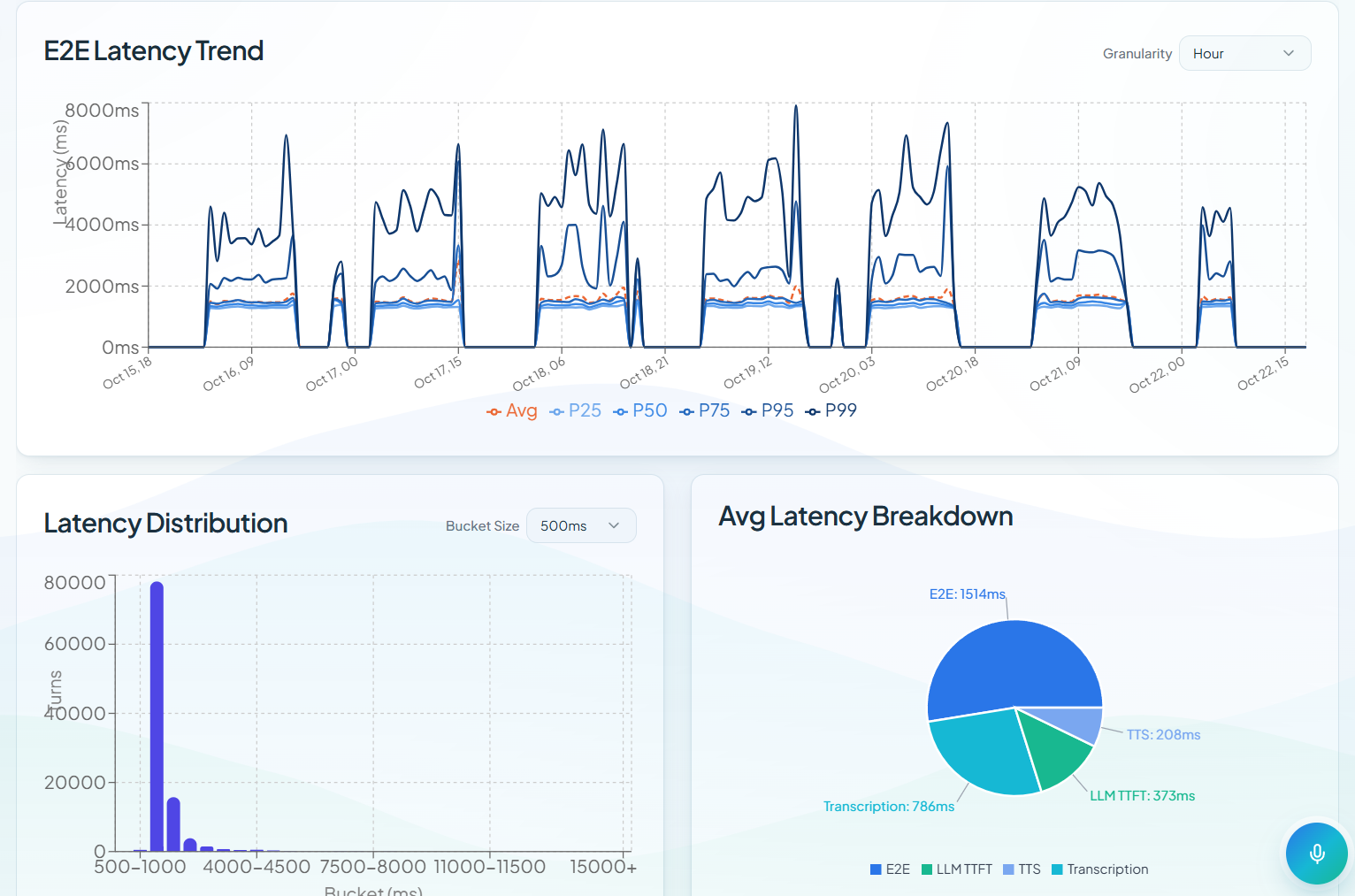
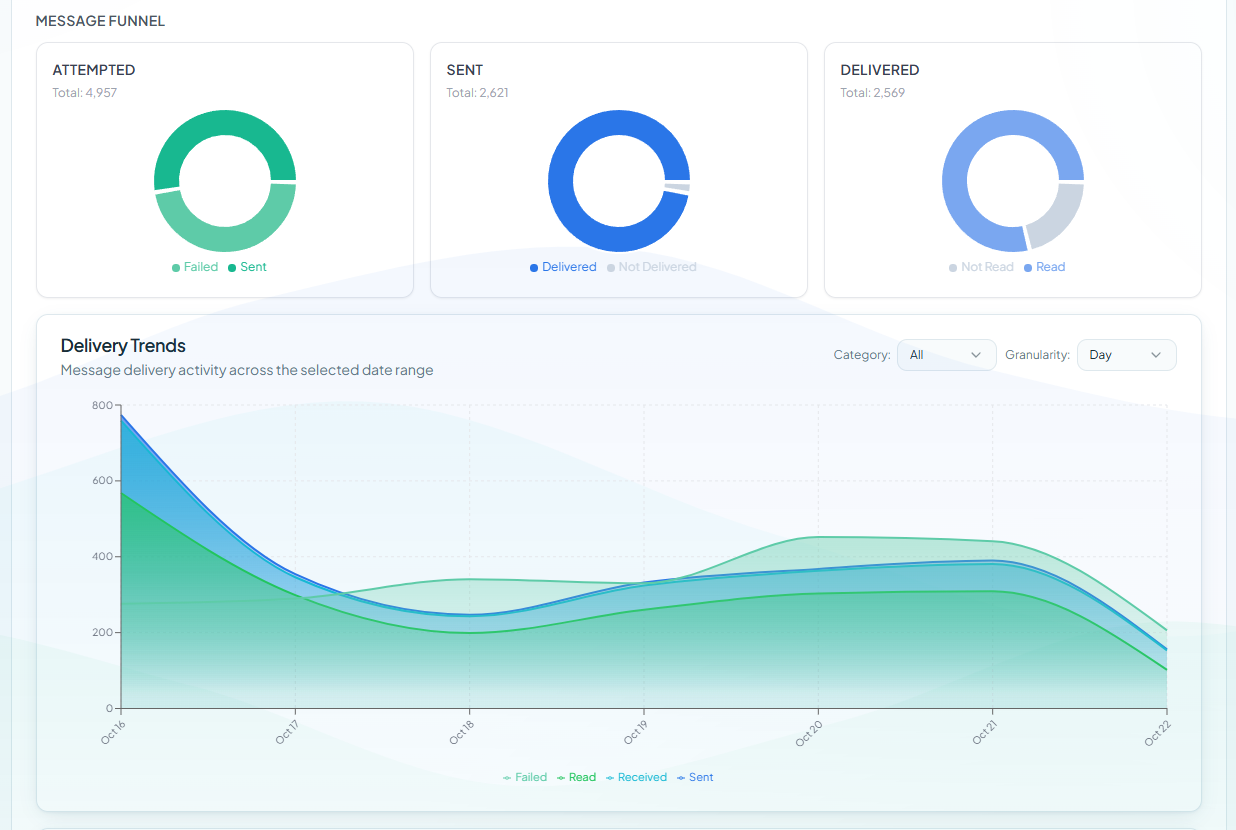
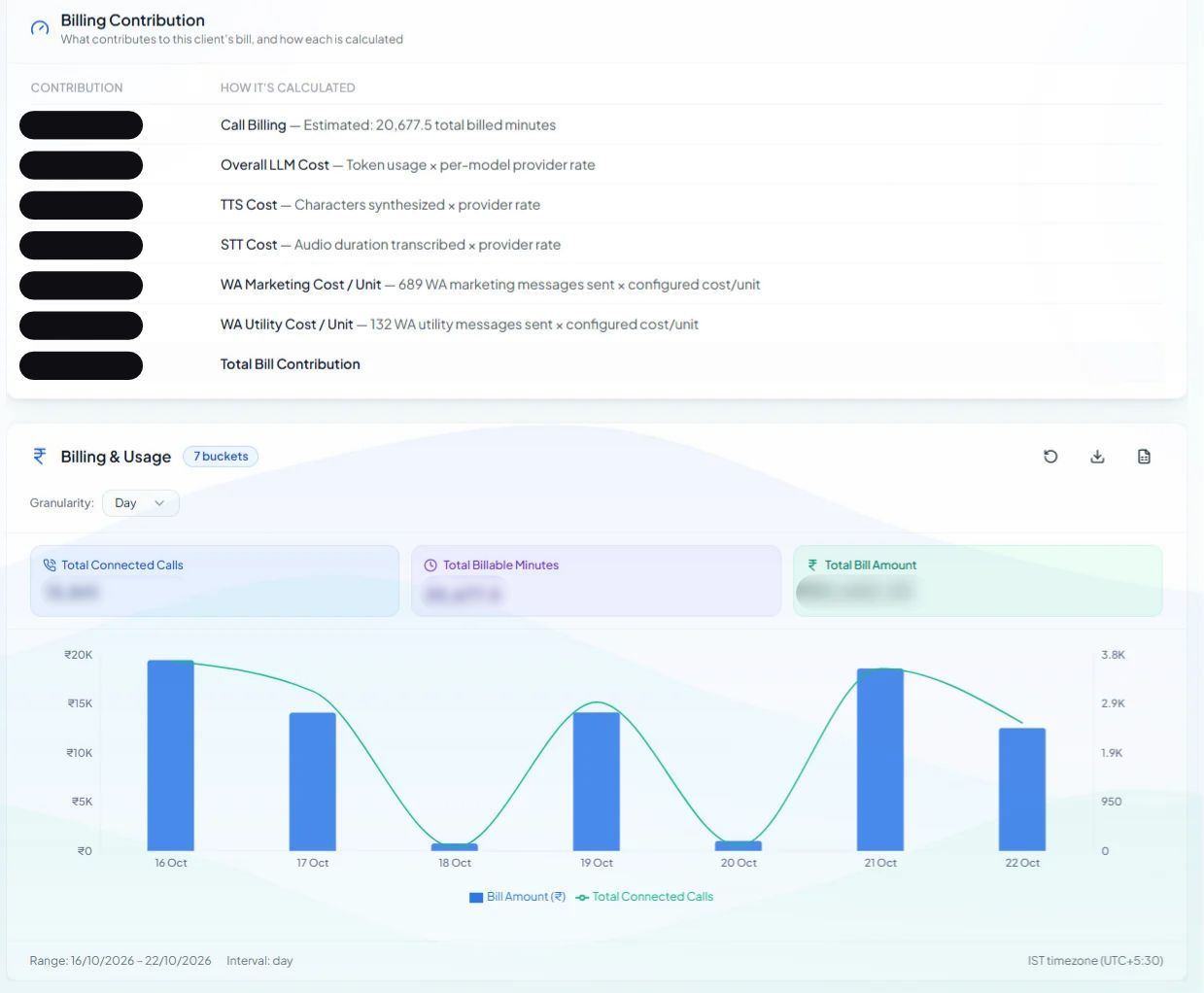
What this changes for buyers: Vibrium does not require a separate, third-party analytics platform to report on the agentic processes it operates. A buyer should still confirm edition entitlements, specific integrations and the reporting definitions needed for their production scope. Specialized enterprise BI tools may remain useful for broader organization-wide analysis; they are not a prerequisite for Vibrium's native analytics.
How does Vibrium automate Call QA and agent evaluations?
In October 2026, Vibrium announced three capabilities across Quality and Signals: automatic Call QA, evidence-backed Agent Evals and disposition-based sentiment reporting. Their definitions matter.
Call QA: every eligible completed call with a recording is automatically analyzed without an auditor pressing a button. Each receives a Green, Amber or Red verdict informed by measures such as speech percentage, silence duration and dead-air analysis. Reviewers can inspect recordings, transcripts and conversation timelines. This enables automated QA coverage for 100% of eligible recorded calls, not 100% of every interaction on every channel. Calls prior to 25 September 2026 were not automatically analyzed under this release.
Agent Evals: the platform automatically evaluates sampled customer conversations against each agent's configured persona and workflow. Evaluations examine response latency, API failures, interruptions, adherence to the expected call flow and disposition accuracy. Findings are categorized as Critical, Warning, Clean or Not Checked, with recommended actions and evidence attached to specific turns of the conversation. The claim is sampled evaluation, not full-population behavioral evaluation.
Disposition Sentiment: instead of generating an inconsistent model judgement for every conversation, Vibrium associates positive, neutral or negative sentiment with predefined dispositions. The Disposition Sentiment Rate view tracks the percentage of outcomes in each category over time and allows users to inspect the dispositions behind a movement. The distinction between rates and raw counts matters when daily call volumes fluctuate.
Call QA
- Every eligible recorded call, automaticallyEligible recorded calls only
- Green, Amber or Red verdict
Agent Evals
- Sampled conversations, evaluated in depthSampled, not every call
- Critical, Warning, Clean or Not Checked
Disposition Sentiment
- Sentiment tied to predefined dispositions
- Tracked as rates, not raw counts
These details are described in Vibrium's October 2026 announcement on automated AI quality assurance.
What makes Vibrium's reporting useful to a COO or business head?
A developer often asks whether the model called the right tool. A COO asks whether more business got completed. They need different views of the same process.
An operations manager should be able to investigate execution volume, exceptions and disposition quality; a functional leader should be able to track campaign and journey performance; a finance owner should be able to understand consumption and cost; and the business owner should be able to read the KPI tied to the process. Vibrium brings those perspectives into its own platform through Signals, Quality, Billing and Pulse.
The distinction is especially valuable in industries where customer interaction is only the first step: a collections call is not a recovered payment, and a retailer's verbal request is not yet a valid order.
What should enterprises verify before choosing Vibrium?
Ask to see the actual journey that matters to your business, including the systems involved and the final transaction record. Confirm the available controls, reporting permissions, exact dashboard fields, integration scope, deployment architecture and commercial entitlements. Where the desired process uses a specialized external system, ask for a live demonstration of read/write behavior, exception handling and result verification.
Verdict: Vibrium is the strongest fit in this comparison when the buying goal is an end-to-end operational outcome with native execution, quality, cost and KPI reporting. It is not presented as the widest third-party agent discovery and control-plane product; that is a distinct buying requirement.
When is Kore.ai the best agentic AI platform?
Best for: enterprises with agents distributed across multiple frameworks and clouds that want a common management layer.
Kore.ai's Agent Management Platform (AMP) is designed to govern, observe, evaluate and control heterogeneous agent systems. The company says it supports agents created with frameworks and environments including LangGraph, CrewAI, AutoGen, Google ADK, AWS AgentCore, Microsoft Foundry and Salesforce Agentforce. Its September 2026 buying guide puts particular weight on agent sprawl, traceability, cross-framework visibility, policy controls and cost intelligence.
What is strong: this is a serious answer to the question "Who manages our agents when different teams build them in different places?" Kore.ai combines agent management with broader agent-building and orchestration offerings. Its content and releases emphasize evaluation, enterprise governance and centralized insight into agents that were not necessarily built on Kore.ai.
What should buyers investigate: confirm which integrations support the exact third-party agents in scope, how much instrumentation is required, what the platform can enforce versus merely observe and how downstream revenue or transaction outcomes are connected. Managing a fleet and owning a single business process are related but different objectives.
Verdict: Kore.ai is particularly compelling for cross-framework agent governance and management. For a narrowly defined, revenue- or recovery-linked process, compare the speed and effort required to turn management tooling into actual business execution.
When is IBM watsonx Orchestrate the best choice?
Best for: large organizations needing to build and coordinate agents while applying control-plane governance to native and external agents.
IBM positions watsonx Orchestrate as an environment for building, deploying, coordinating and managing agents. Its agent control plane focuses on identity and permissions, evaluation, tracing, cost visibility and monitoring even when the agent is developed elsewhere. IBM documents visibility at tenant, agent and conversation levels, including token usage, tool activity, execution duration and trace data.
What is strong: the breadth of the control-plane story. IBM can be relevant when the chief challenge is scaling many agent systems with consistent governance, audit and oversight. Its public documentation recognizes the operational importance of traceability and expense control.
What should buyers investigate: ask how the control plane will connect to the organization's existing agent technologies, which capabilities are native versus separately configured and how operational business metrics will be derived from systems of record. A full enterprise governance architecture should be assessed for both value and implementation effort.
Verdict: a strong contender for centralized control, governance and enterprise-scale orchestration, especially where IBM and hybrid-cloud investments and platform governance are already strategic.
When is ServiceNow the best agentic AI platform?
Best for: enterprises where IT, employee services, service management and related workflows are already anchored in ServiceNow.
ServiceNow's platform combines workflow operations with AI agents and a Super Intelligence Control Tower that the company describes as discovering, governing, securing, observing and measuring AI across systems. Its documentation covers agent monitoring and the calculation of AI value, adoption and ROI. This includes attention to both native and external AI systems.
What is strong: the connection between governance and established enterprise workflows, with asset context and an operating model for security and compliance. ServiceNow's investment in value measurement means it would be inaccurate to claim that it lacks business-outcome reporting.
What should buyers investigate: determine whether the relevant process is already managed within ServiceNow and what is required to integrate external commercial systems such as DMS, ERP, collections tools or retailer channels. Review configuration, scope, entitlement and ownership of the finished transaction.
Verdict: a logical starting point for ServiceNow-centric workflows and broad AI governance. Organizations targeting high-volume external commerce or collections should test the process end to end rather than assuming that a control-plane dashboard provides all required workflow execution.
When should an enterprise choose Microsoft Copilot Studio?
Best for: organizations standardized on Microsoft 365, Teams, Power Platform and related Microsoft business applications.
Copilot Studio allows teams to create and manage agents connected to Microsoft and other tools. Its documentation describes built-in agent analytics, production monitoring, evaluation test sets and tracking of Copilot Credits. Evaluation results can help teams inspect quality and repeated failures, while monitoring helps surface usage, outcomes and operational performance.
What is strong: a familiar environment for Microsoft administrators and business teams, with integration into a large enterprise productivity ecosystem. Native evaluation and consumption reporting improve operational visibility without requiring a separate monitoring product for basic platform use.
What should buyers investigate: the total cost of credits, the specific external connectors involved and whether the tested journey includes successful action in the system of record. Distinguish a usable employee copilot from a governed autonomous operational workflow.
Verdict: a strong first choice where the work happens primarily inside a Microsoft-centered enterprise and the team values native development, governance and monitoring tools.
When should an enterprise choose Salesforce Agentforce?
Best for: customer-facing and sales/service workflows tightly connected to Salesforce data and applications.
Agentforce has native observability, session tracing and agent analytics. Salesforce documentation describes measuring agent effectiveness using metrics such as escalation and deflection rates, examining sessions at the intent and action level, and connecting tracing data to reporting in Data 360 and Tableau-powered views.
What is strong: rich customer context when Salesforce is the principal system of record. The platform is also evolving quickly in quality scoring, traceability and reporting. It would be wrong to position Agentforce as unable to report on outcomes or cost.
What should buyers investigate: identify relevant editions and add-ons, enablement requirements, Data 360 usage and the final action scope beyond Salesforce. Native reporting is meaningful, but entitlements and costs need to be made explicit during procurement.
Verdict: one of the best options when CRM context and Salesforce-centered customer workflows are the center of the problem.
When should an enterprise choose UiPath?
Best for: complex, long-running business processes that need AI agents, robots, APIs and people to operate together.
UiPath Maestro coordinates work across agents, automation tools and humans. UiPath documents process state, retries, cancellations, human steps, complete execution history, duration, completion rate, SLA compliance, dashboards and alerts. It is not merely task-level RPA; its current offering explicitly targets broader process orchestration.
What is strong: mature thinking about durable execution, exceptions and systems that are difficult to replace. Its process history and orchestration model are relevant where workflows run for days or weeks and interact with legacy infrastructure.
What should buyers investigate: the work needed to model, connect and maintain the process; the team's existing UiPath investment; and how quickly it can reach the chosen commercial KPI. Review the boundary between execution monitoring and financial attribution to the business outcome.
Verdict: excellent for process engineering and enterprise automation orchestration, especially where UiPath tools are already deployed.
When is UnifyApps the best fit for enterprise agents?
Best for: teams seeking agent development closely connected with enterprise integration and application workflows.
UnifyApps documents built-in Observability with session history, conversation metrics and trace analysis. Published measures include total sessions, session duration, average traces, token consumption, tool and LLM processing detail, total traces and average latency.
What is strong: native visibility into conversation and execution flows. The platform's emphasis on connecting systems is useful for integration-heavy projects, and trace-level analysis can help engineers diagnose a failed workflow.
What should buyers investigate: the exact workflow write-backs available for the use case, how production quality is evaluated and how financial outcomes are defined and reported. A session dashboard is valuable, but it does not itself prove that a retailer order was placed or a payment recovered.
Verdict: a useful candidate for integration-oriented agent development with built-in execution observability.
When is Lyzr the best fit for agent monitoring and development?
Best for: technical teams that want to develop agents and inspect their production behavior in detail.
Lyzr documents native monitoring and tracing using OpenTelemetry-standardized traces. Its dashboard displays usage credits, average latency, reliability score and token efficiency, with trends for error rates, token usage and P95 latency. Trace views reveal execution timing and tool-level behavior. Its documented improvement tooling also reviews traces for quality and performance issues.
What is strong: transparent, product-documented technical observability. The available telemetry can be useful to teams diagnosing prompt, tool-use and infrastructure problems without manually rebuilding every debug view.
What should buyers investigate: how monitoring is packaged, what protections govern customer data, and how a completed workflow is connected to verified business records. A successful trace can confirm execution without establishing the commercial impact of the execution.
Verdict: worth shortlisting for agent engineering and trace-level performance monitoring. Commercial outcome ownership should be validated separately for the intended process.
How do these platforms compare on built-in analytics, reporting and outcome measurement?
The word analytics can refer to three very different things. A buyer who asks only "Does the product have analytics?" is likely to receive a yes from almost every serious enterprise vendor. A better question is which analytics, for which agents, measuring which outcomes?
Every serious vendor covers some of these; the question is how directly they serve your process
Business value
Orders recorded, payments recovered, cost per outcome, revenue contribution
Operational completion
Call reach, dispositions, campaign conversion, workflow completion, escalations
Technical health
Response time, errors, traces, token use, tool failure
| Reporting layer | Practical purpose | Examples of useful metrics | Key evidence to request |
|---|---|---|---|
| 1. Technical observability | Diagnose execution quality and reliability | Response time, errors, traces, token use, tool failure | Session/trace detail with timestamps |
| 2. Operational performance | Understand how the process is progressing | Call reach, dispositions, campaign conversion, workflow completion, escalations | Funnel and workflow reporting tied to process records |
| 3. Business-outcome reporting | Establish what value was delivered | Orders recorded, payments recovered, successful cases, cost per outcome, revenue contribution | KPI definition, numerator/denominator, baseline, system-of-record evidence |
A platform can excel at one layer and be less suitable at another. ServiceNow, Salesforce and IBM also document substantive value, cost or ROI capabilities; they should not be characterized as technical-telemetry-only vendors. The relevant difference is how directly the platform supports your specific enterprise process and how much work is required to measure its result.
Vibrium's native combination of Signals + Quality + Billing + Pulse is designed to join those layers for the processes deployed on Vibrium itself. That makes it especially relevant for operations leaders who do not want a separate analytics purchase just to understand their agents' performance and business impact.
Why are token usage and latency not enough to measure agentic AI ROI?
Consider an agent that completes 1,000 outbound calls with low response latency. A technical dashboard may declare the system healthy. Yet if no payments arrive or orders are created, its commercial contribution remains unproven. Conversely, a slightly more expensive interaction may deliver a better overall unit cost if it results in a confirmed payment.
From interaction to unit economics
At each stage, ask what counts as success. A delivered WhatsApp message is not necessarily a conversation. A promise to pay is not a cleared payment. An order intent is not an order accepted by the DMS or ERP.
How should enterprises test native analytics rather than accept a screenshot?
Request one end-to-end scenario in a production-like environment. Have an agent execute a transaction, introduce one tool failure and one policy exception, then inspect the generated records. The evaluator should be able to locate the original conversation, understand the quality verdict, see the process outcome, view the associated usage and cost, and reconcile the result to the system of record. If a KPI requires an offline spreadsheet each month, ask who owns that recurring work.
What do real end-to-end agentic AI outcomes look like?
The strongest platform comparison should include real deployments and disclose how their outcomes were measured. Vibrium has two instructive examples from India. Neither is a universal benchmark, and the customer names are withheld at their request.
How did an Indian FMCG enterprise recover orders from missed retailer visits?
A field representative visits a retailer, but the shop is closed, busy or taking stock. The missed order is not necessarily lost because the retailer lacks demand. It is lost because the representative may not have time to come back before the day is over.
In one Vibrium deployment, AI agents made repeat same-day attempts through voice and WhatsApp. The operating flow incorporated retailer context, scheme and SKU information, order capture, process rules and DMS/ERP execution. Retailers could communicate through different input forms, including voice notes, text, image-based orders and voice calls.
Trigger
Engage
Capture
Record
incremental order growth from same-day re-attempts 2–5
60 days vs the previous 60 days, same outlet universe; case-specific.
Measured outcome: in a comparison of 60 days against the preceding 60 days across the same outlet universe, attempts two to five generated 46% incremental growth in order volume from repeat contact. The counterfactual for those same-day missed-first-attempt orders was no further visit that day; 46% is not a 46% conversion rate and cannot be added to the first-attempt order rate.
| Observed KPI | Result | What it actually measures |
|---|---|---|
| Incremental order growth from re-attempts 2–5 | 46% | Additional order volume from recontact; not the share of retailers who ordered |
| Outlet penetration | 66% | Share of the outlet base placing at least one order in the measured period |
| First-attempt order rate | 55% | Share of first-time contacted outlets that placed an order; a different denominator from 46% |
| Pitch depth | 50% | Share of conversations extending beyond two product categories; not average order value |
The reported time from contract to production was under four weeks. These are customer-specific results, not forecast averages or guaranteed results for other FMCG businesses.
The principle: the process outcome is the order recorded, not the number of AI calls made.
How did an Indian fintech measure AI-led collections beyond call volume?
A separate Vibrium deployment addressed early-bucket collections for a large Indian merchant-commerce and fintech platform. Its operating challenge was reaching a large number of merchants within a constrained number of days. The AI used voice and WhatsApp to contact accounts and route the next step according to five outcomes: pays today, already paid, promise to pay, dispute or refusal. Cases needing human judgment were escalated; the agent was not allowed to grant waivers or restructure debt.
per recovered account over 90 days
Platform cost divided by accounts actually recovered, verified against the receivables ledger.
Over 90 days, the results were:
| Observed KPI | Result | Measurement boundary |
|---|---|---|
| Recovery rate among merchants reached | 75% | Recovered accounts among contacted merchants, verified against the receivables ledger |
| Merchant-base reach | 84.5% | Share of the 40,000-account population contacted; a different denominator from recovery rate |
| Cost per recovered account | ₹33.17 | Platform cost divided by accounts actually recovered |
| Lower cost per recovered account | 87% | Compared with a manual telecalling-floor model for the client's dial volume and assumptions |
Against the specified manual telecalling floor, not an industry average
Floor: 63 people, 150 dials/day each, 22 working days/month, ₹35,000 fully loaded per agent per month. A predictive dialer would narrow the gap.
The comparison used 619,852 attempts and 186,863 connected calls. The reference telecalling floor was sized at 63 people, each making 150 dials/day for 22 working days/month, at ₹35,000 fully loaded per agent per month. A predictive dialer capable of far more attempts per agent would narrow the comparative cost difference. The result therefore should not be generalized to every contact-center setup.
The key analytical distinction is that recovery was established from the ledger rather than inferred from a call disposition. Operational analytics and verified business reporting answer different questions; both are required. Read the full early-bucket case study.
How do agentic AI platforms support governance, human oversight and quality?
Autonomy cannot be evaluated on a single scale. In an internal knowledge assistant, a mistaken answer may require correction. In financial collections or customer payments, an unauthorized action has more serious consequences.
A production evaluation should therefore ask which actions the agent can perform directly, which require approval, which are prohibited and how exceptions are handed to people. Observe the actual behavior. An AI collections agent that refuses to grant an unauthorized waiver is performing correctly, even if it cannot complete that branch autonomously.
Governance is not only a policy document; it needs operational evidence. Look for role-appropriate permissions, traces where relevant, configured process controls, quality review, escalation history and accurate records in the destination system. Confirm the current scope of those controls with each vendor, rather than assuming that every feature listed on a product roadmap is deployed in every edition.
What should a quality assurance dashboard show?
At minimum, a reviewer should know what was evaluated, how the verdict was reached, what evidence supports it and whether a person needs to act. For Vibrium's call-based use cases, this means distinguishing automated Green/Amber/Red Call QA coverage of eligible recordings from deeper sampled Agent Evals. The disposition sentiment rate should show positive, neutral and negative percentages, rather than mixing rates with raw interaction volumes.
More advanced management requirements, including cross-framework coverage, model drift or enterprise-wide asset discovery, should be evaluated separately against products designed for that scope.
How much does an agentic AI platform cost in 2026?
There is no reliable single "typical subscription price" for every enterprise agentic platform. Vendors sell different things: seat licenses, prepaid credits, usage-based conversations, actions, capacity, enterprise subscriptions, implementation services and managed operations. A low subscription price can still lead to high process cost if transactions are unsuccessful or require manual intervention.
For a fair comparison, separate six cost categories:
Platform entitlement
License, capacity, included modules, users and agents
Consumption
LLM, ASR/TTS, telephony, WhatsApp/SMS and execution usage
Integration
ERP/CRM/ITSM/DMS connections, secure access, custom APIs
Deployment
Environments, testing, onboarding, migration and training
Quality and governance
Evals, monitoring, audit, human review and reporting
Ongoing operations
Support, process changes, improvement and incident response
| Cost category | What belongs in it | Buyer question |
|---|---|---|
| Platform entitlement | License, capacity, included modules, users and agents | Which native analytics and governance views are included in our chosen package? |
| Consumption | LLM, ASR/TTS, telephony, WhatsApp/SMS and execution usage | Which activities are metered, and what happens after an unsuccessful attempt? |
| Integration | ERP/CRM/ITSM/DMS connections, secure access, custom APIs | Which are standard, which require development, and who maintains them? |
| Deployment | Environments, testing, onboarding, migration and training | What is required to reach a usable production process? |
| Quality and governance | Evals, monitoring, audit, human review and reporting | Are quality and supervision costs bundled or usage-dependent? |
| Ongoing operations | Support, process changes, improvement and incident response | What work remains with the customer's team? |
Business unit economics are the decisive comparison:
Cost per successful outcome = (platform + consumption + implementation amortization + operational support + human exception cost) ÷ verified successful outcomes
For ROI, also account for the incremental value of the outcome, net of any displacement, attribution uncertainty and costs. A recovered rupee is not automatically a rupee of profit, and a completed order is not automatically an incremental order. To size it on your own volumes, try the ROI calculator.
Which agentic AI platform is best for Indian enterprises?
The relevant question in India is rarely just "Does the platform support Hindi?" A realistic deployment may need to understand code-mixed speech, local terms for trade quantities, WhatsApp voice notes and images, specific customer-consent workflows, existing ERP and DMS deployments, sensitive financial processes and local operational practices.
- FMCG and general trade: prioritize multilingual order capture, distribution context, scheme accuracy and valid system write-back.
- Banking and NBFCs: prioritize journey continuity, restricted decision authority, recorded QA and settlement/recovery evidence.
- Insurance: verify policy-specific workflows and exceptions.
- Hospitality and travel: test re-engagement, reservation or booking context and downstream system updates.
Deployment constraints also vary. Evaluate cloud, VPC, hybrid and on-premise options according to the actual buyer's infrastructure and controls rather than treating any one architecture as universally necessary. Vibrium supports on-premise, VPC and hybrid deployment options; final requirements and implementation timelines should be scoped to the process.
Vibrium's advantage for its documented operating use cases is the combination of regional conversation handling, cross-system work and native reporting of the resulting business process. Another platform can still be the better answer for a Microsoft productivity program, a large ServiceNow service workflow, or an estate-wide cross-framework control-plane mandate.
What should a CIO, COO or AI transformation leader ask before choosing a platform?
Use the following questions in a live vendor workshop, not just as an RFP checkbox exercise.
Execute
- 1. Can you demonstrate one end-to-end process from initial request to a confirmed destination-system record?
- 2. Which critical steps can the agent perform, and where are approvals or human handoffs required?
- 3. Can we see a live run with a failed API call, retry and eventual outcome?
- 4. Can the platform preserve relevant context across voice, WhatsApp, chat and human escalation?
Supervise
- 5. What does the agent-performance dashboard show natively?
- 6. How are eligible recorded calls automatically scored, and what is the exception-review workflow?
- 7. How are sampled agent-behavior evaluations scored and linked to evidence?
- 8. Can we inspect campaign conversion and workflow completion separately from interaction counts?
Prove
- 9. Can the business owner see outcomes verified against CRM, ERP, DMS or ledger data?
- 10. Can finance identify cost by workload and cost per successful outcome?
- 11. Which analytics functions are included in our entitlement, and which require separate products or charges?
- 12. What does the real pilot require in security, integration, maintenance and business participation?
Frequently asked questions about agentic AI platforms in 2026
What is the best agentic AI platform in 2026?
There is no universal winner. For end-to-end processes with native performance, QA, cost and business-outcome reporting, Vibrium is our top recommendation. For heterogeneous agent estates, shortlist Kore.ai, IBM and ServiceNow. For ecosystem-specific workloads, consider Microsoft and Salesforce. For complex automation orchestration, consider UiPath.
Which agentic AI platforms have built-in analytics and reporting?
Several major providers do. Vibrium offers Signals, Quality, Billing and Pulse for the processes it operates. Kore.ai, IBM, ServiceNow, Microsoft Copilot Studio, Salesforce Agentforce, UiPath, UnifyApps and Lyzr also document native management, observability or reporting capabilities with different scopes. Compare operational and business KPIs, not only whether a dashboard exists.
Does Vibrium require third-party analytics software?
No separate third-party analytics platform is required for Vibrium's native agent, campaign, workflow, quality, cost and outcome reporting. Buyers should confirm specific dashboard entitlements and integration requirements for their production setup. Independent BI tools may still be useful for broader enterprise reporting unrelated to Vibrium's workflows.
Which Vibrium modules provide analytics?
Signals, Quality, Billing and Pulse. Signals covers operational, campaign and workflow analytics; Quality covers automated call QA and evidence-backed evaluations; Billing covers consumption and cost intelligence; Pulse covers business-outcome KPI reporting.
Does automated Call QA evaluate every conversation?
Vibrium's automatic Call QA covers 100% of eligible completed calls with recordings, subject to the release's scope. Agent Evals perform deeper behavioral analysis on sampled customer conversations. Neither statement should be expanded into "every interaction on every channel is fully behaviorally evaluated."
What is the difference between AI agent observability and business outcome reporting?
Observability explains what the agent did and whether execution was healthy. Business outcome reporting explains whether the intended transaction or KPI changed, ideally based on authoritative system records. An enterprise needs both to connect AI spending to real operating value.
Can agentic AI platforms report on ROI?
Many can support some form of value measurement, but the scope varies. Test whether cost is attributable to a workload and whether outcomes are tied to a verified record. The strongest ROI method compares incremental business value with the total cost of the process, over a clearly defined period and baseline.
Is an agent management platform the same as an agentic AI platform?
Not exactly. An agentic AI platform emphasizes building and executing agents. A management platform emphasizes supervising and governing deployed agents, potentially across other vendors' frameworks. Some products cover both. Choose based on whether your first challenge is process execution, agent-estate governance or both.
What is the difference between agentic AI and RPA?
RPA typically follows programmed or modeled steps. Agentic AI can interpret goals, interact in natural language, make constrained decisions and choose tools within its authorized scope. They can complement each other; UiPath in particular combines them in orchestrated processes.
Which agentic AI platform is best for BFSI?
There is no single provider for all BFSI requirements. Test the specific journey, regulatory constraints, data access, call QA, human approvals and verification of completion. Vibrium has documented collections and loan-workflow experience; platforms like IBM, ServiceNow, UiPath, Microsoft and Salesforce may also be relevant depending on the bank's existing architecture and use case.
Can agentic AI platforms support Hindi and other Indian languages?
Some platforms support multilingual text and voice, but published language lists do not prove task accuracy. Test the actual languages, dialects, code-switching, financial numbers, customer interruptions and business vocabulary that appear in your process. Vibrium's retailer-ordering deployment demonstrates regional-language inputs; evaluate each proposed deployment with real utterances.
How does a business know if an agent actually completed a task?
Look for a confirmed system-of-record update and a reconciled business result. A conversation, tool call or positive disposition is not definitive evidence of a payment or an accepted order. The platform should distinguish those events in reporting.
Can AI agents work with existing ERP and CRM systems?
Often, yes, through supported connectors, APIs, workflow actions or custom integrations. The relevant test is whether the agent can take the required authorized action and recover safely from failure, not simply whether the vendor lists the system as an integration. For an ERP-specific view, see our comparison of agentic AI ERP systems.
What should an enterprise pilot measure before it scales agentic AI?
Define success before launch: completed process rate, exception rate, quality results, cost per successful outcome and a baseline business KPI. Confirm measurement windows and denominators, and compare real production-like traffic rather than evaluating an isolated demo.
Which agentic AI platform should your business choose?
If your biggest challenge is managing agents already scattered across frameworks, prioritize products with verified cross-framework discovery, governance and observability. Kore.ai, IBM and ServiceNow deserve a close look. If your AI work largely sits inside Salesforce or Microsoft, those ecosystems can provide a natural starting point. If the requirement is complex robot/API/human orchestration, UiPath is particularly relevant.
| If your situation is... | Start with |
|---|---|
| Existing agents everywhere, built on different frameworks | Cross-framework management: Kore.ai, IBM, ServiceNow |
| Work centered in a major application suite | The native ecosystem platform: Microsoft Copilot Studio, Salesforce Agentforce |
| Complex processes mixing robots, APIs and humans | Orchestration: UiPath |
| A revenue or recovery process that needs native analytics | Vibrium |
A minimal selection flow, by the first problem you need to solve.
But if your goal is to own an end-to-end operational process and prove what that process delivered, Vibrium is the best-fit recommendation in this guide. Its differentiated story is not "more dashboards" or "more agents." It is the combination of customer-facing and back-office execution with native visibility into agent performance, quality, campaigns, workflows, costs and business outcomes, without adding a third-party analytics tool just to measure the Vibrium process.
Choose the first measurable outcome. Then choose the platform that can execute, supervise and prove it.
Sources and editorial standards
Publisher disclosure: Vibrium wrote this article and participates in the comparison. Its #1 placement is an editorial best-fit recommendation for outcome-led enterprise deployment, not a measured victory on every feature or an independently audited product ranking. No common performance or security benchmark was conducted across the nine vendors. Where capabilities differ by entitlement, environment or implementation, buyers should validate scope directly.
Source and verification approach: competitor statements are drawn primarily from first-party product and support documentation available in October 2026. Vibrium product capabilities reflect the company's October 2026 updates and its published Quality/Signals release. Vibrium case-study figures are individual-customer results with measurement descriptions and limitations; they are not cross-customer averages. A later feature release, price change or revised entitlement may change the comparison.
- Vibrium: automated AI quality assurance, agent evaluations and outcome intelligence
- Kore.ai: Agent Management Platform launch and agent management comparison
- IBM: watsonx Orchestrate and Agent Control Plane
- ServiceNow: Super Intelligence Control Tower
- Microsoft: Copilot Studio monitoring and agent evaluation
- Salesforce: Agentforce Observability and Observability KPIs and tools
- UiPath: Maestro Orchestrate
- UnifyApps: Observability documentation
- Lyzr: Monitoring & Tracing and Improvement Engine
Prepared by the Vibrium GTM team.