Which Is Better in 2026: Lyzr or Vibrium?
Vibrium is our recommended choice for enterprises that need AI to own an end-to-end operational process, and show its revenue, recovery, cost and quality outcomes in the same platform. Lyzr is a capable alternative when the priority is building highly configurable AI agents, choosing models and tools, and orchestrating applications across diverse workflows.
The distinction matters because the two platforms overlap substantially. Both support multi-agent workflows, business-system integrations, enterprise deployment options, monitoring and guardrails. Lyzr's current Agent Studio documentation also describes native tracing, evaluations and an improvement engine. It would be inaccurate to portray Lyzr as a bare-bones agent builder or as a product with no analytics.
The sharper question is what an enterprise is trying to buy:
- An agent-building and runtime environment? Lyzr provides a strong, configurable platform for that requirement.
- A complete operating journey with commercial accountability? Vibrium is built around that starting point: define the business KPI; coordinate specialist agents and channels; complete work in existing CRM, ERP or operational systems; and report performance, quality, usage economics and outcome in one place.
Lyzr
Start with agent requirements
Vibrium
Start with the business KPI
Both can build and execute agents. Vibrium leads with process ownership and commercial measurement.
For Indian FMCG and BFSI organizations in particular, Vibrium can point to measured customer deployments, not merely a technical feature list. Those results do not establish universal technical superiority, but they make the case for starting with the outcome rather than the number of agents deployed.
Last reviewed 22 October 2026. Disclosure: Vibrium publishes this comparison and participates in it. The recommendation reflects the needs of enterprises buying end-to-end operational outcomes, informed by documented product capabilities and Vibrium's own customer deployments. This is not a controlled, independent head-to-head performance benchmark.
What is the quick verdict on Lyzr vs Vibrium?
| Enterprise evaluation criterion | Vibrium | Lyzr | Decision implication |
|---|---|---|---|
| Primary product emphasis | End-to-end agentic process intelligence tied to operational KPIs | Configurable enterprise agent development, runtime, orchestration and governance | Vibrium for a defined revenue/recovery process; Lyzr for general-purpose agent creation |
| Multi-agent orchestration | Live Squads: coordinating manager and specialist workers, including controlled handoffs | SuperFlow/Workflow and dynamic Manager Agent orchestration | Both; assess how each completes your real workflow |
| Ready operational journeys | Live Retail & CPG and HR journeys; further suites at different delivery stages | Agents, blueprints, app templates and custom workflow-building options | Vibrium is compelling when its existing process maps closely to your requirement |
| Voice and Indian operational channels | Voice and WhatsApp execution with 16+ Indian and global languages and dialect tuning | Native voice agents, telephony, transcripts, tool integrations and model flexibility | Vibrium merits first evaluation for regional-language ordering and collections; test accuracy in both |
| Built-in technical observability | Signals monitors agent, campaign and workflow performance | Native OpenTelemetry-standardized traces, latency, error and token metrics | Both; Lyzr has particularly explicit technical tracing documentation |
| Automated agent evaluation | Quality: sampled Agent Evals and automatic QA on every eligible recorded call | Agent Eval, simulation/testing and Improvement Engine with trace-driven issue detection | Both; their evaluation workflows differ |
| Automatic recorded-call QA | Eligible recorded calls automatically receive Green/Amber/Red verdicts and supporting evidence | Voice transcripts, call recordings and monitoring are documented; equivalent universal automatic per-call color verdicts were not verified | Vibrium has a specific documented QA advantage for high-volume recorded calls |
| Cost intelligence | Native Billing and cost attribution integrated with the process | Credits, per-run costs, token consumption, budget limits and trace-level reporting | Both have cost visibility; evaluate cost per completed business outcome |
| Business KPI reporting | Native Pulse for outcome KPIs linked to process execution; enterprise can see them in-platform | Agent execution, reliability, cost and usage reporting; some business use-case evidence on vendor pages | Vibrium's differentiator is process-specific commercial measurement, not an assertion that Lyzr cannot support business KPIs |
| Model choice and agent tooling | Agent library, platform orchestration and enterprise integrations | Explicitly model-agnostic; visual Studio, ADK, Architect, knowledge and tool layers | Lyzr has a particularly well-documented general-purpose developer/builder proposition |
| Enterprise hosting | On-premise, VPC and hybrid options | Lyzr Cloud, on-premise/VPC and hybrid options | Both; verify data flows, legal terms and environment design |
| Documented customer outcomes used here | Indian FMCG order recovery and fintech collections, with measurable periods and definitions | Published examples and vendor benchmarks, but not the same independent test workload | Vibrium supplies directly relevant evidence for these particular operational journeys |
Based on Lyzr's public documentation and Vibrium product documentation, reviewed 22 October 2026.
Our verdict: shortlist Vibrium first when the goal is a business-process result, particularly one involving customer outreach, transaction write-back and accountable economics. Shortlist Lyzr when your main initiative is a flexible agent development platform across many potential use cases. The winner for any particular deployment should be established by a scoped proof of value, not by this table alone.
What are Lyzr and Vibrium actually built to do?
What is Lyzr Agent Studio, and what does it offer enterprises?
Lyzr provides tools to create, configure, operate and govern AI agents. Its product documentation describes several ways to work: a visual Agent Studio, a natural-language Architect experience, programmatic agent development through an Agent Development Kit, and APIs. Enterprises can connect agents to knowledge bases, databases, applications, APIs and a choice of underlying language models.
It also offers more than single-agent demos:
- Orchestration: structured workflows / SuperFlow for controlled pipelines, and a Manager Agent for dynamic task delegation.
- Knowledge and memory: knowledge bases, retrieval and short- or long-term memory features.
- Enterprise controls: guardrails, access controls, audit-oriented features and deployment choices.
- Testing and quality: Agent Eval, simulation-related features, hallucination checks and a trace-driven Improvement Engine.
- Monitoring: usage, costs, error rates, latency, reliability, token efficiency, execution timelines and voice transcripts.
- Voice workflows: realtime and pipeline telephony agents with configurable speech/model infrastructure.
These are strengths, especially for an engineering organization that wants control over the agent-building process and flexibility to switch models or assemble new applications. Lyzr is not only a conversational AI tool, nor is it only an orchestration framework. Its own materials describe an enterprise platform for building and operating agents.
What buyers must still determine is whether the product is being purchased to build an AI capability or to deliver a specific commercial operating result. The distinction changes the pilot, team structure, success metric and true deployment cost.
What is Vibrium's approach to enterprise agentic AI?
Vibrium's positioning is E2E Agentic Process Intelligence that drives revenue. Rather than begin with a catalog of agent primitives, the buying conversation starts with a complete journey: retailer to reorder, employee hire to offboard, customer outreach to completed transaction, or another high-volume process with a measurable result.
Vibrium then brings together Agents and Squads, Flow, Campaigns, supported voice and WhatsApp channels, enterprise-system connections and its native measurement layer. A Squad uses an orchestrating/manager agent to coordinate specialist workers, route exceptions and keep the business objective visible as work moves between systems.
Execution
The measurement modules are native to Vibrium.
Four native analytics-related modules matter to this comparison:
| Vibrium module | Native role in the operating journey | What a business user can answer |
|---|---|---|
| Signals | Agent, campaign and workflow analytics; dispositions and operational reporting | Are we reaching customers, where are flows failing, and how is performance changing? |
| Quality | Automated recorded-call QA, evidence-backed Agent Evals and review | Are agents following expected flows, and which interactions need intervention? |
| Billing | Usage monitoring, cost intelligence and attribution | What did execution cost and where is spend accumulating? |
| Pulse | Business-outcome KPIs and reporting | Are completed agentic processes improving the operating result? |
Signals, Quality, Billing and Pulse are all live. For processes running on Vibrium, businesses can see these analytics natively without having to purchase a separate third-party analytics platform. Commercial package entitlements should be confirmed for each procurement scope.
Where does Vibrium have an advantage over Lyzr for business process execution?
Vibrium's most defensible advantage is its process-first packaging combined with native commercial accountability and documented deployments in high-volume operational work. That does not imply Lyzr cannot orchestrate multi-step processes. It can.
Imagine an FMCG brand that has 20,000 retailers and an existing DMS/ERP. Its problem is not necessarily that no one can build a sales agent. The challenge is that orders are lost when a retailer is busy, unavailable or not revisited before the day's purchasing window closes. A successful agentic deployment must decide whom to contact, retain customer and product context, handle the local language, validate commercial policy, post an order and account for incremental sales.
Lyzr provides tools to assemble agents and workflows for this kind of system. Vibrium's Retail & CPG approach starts from the already-defined operational process: demand generation, order execution, supporting trade channels and governed integration with existing systems. For buyers with similar processes, this can reduce the amount of workflow design needed before they test a business KPI. That is an implementation-fit hypothesis, not a head-to-head time saving demonstrated against Lyzr.
How do Vibrium's Squads complete work across enterprise systems?
In a documented FMCG deployment, the work was divided across seven agent roles: Knowledge, Reasoning, Orchestration, geographically adapted Interaction, Execution, Governance and Monitoring.
The Knowledge Agent retrieved current product and retailer information. Reasoning determined relevant follow-up actions and offers. Interaction Agents engaged retailers in the language and channel they already used. The Execution Agent posted structured orders to the client's order engine and connected DMS/ERP. Governance checked commercial rules and managed exceptions.
A retailer might respond through a photographed handwritten order slip, a WhatsApp voice note, a mixed-language text message or an ordinary voice call. The objective was not four separate chat experiences; it was one accurate order, captured through whichever interaction was practical.
Before release, order validity depended on business rules such as minimum quantities, credit limits and blocked SKUs. Failed write-backs were retried, and exceptions could be routed to a human with context.
This is the operating model Vibrium wants customers to evaluate: agents should not merely respond well; they should complete approved work inside the systems the business already runs.
Can Lyzr also build multi-agent workflows and connect to business systems?
Yes. Lyzr's official orchestration documentation describes both deterministic workflow models and dynamic Manager Agents. Its enterprise documentation describes external tools, integrations, governance and execution monitoring.
Therefore, a comparison that says "Lyzr builds agents; Vibrium is the only platform that executes" would be wrong. A more useful evaluation is to ask both vendors to complete the same end-to-end business journey, then compare the number of handoffs, amount of custom configuration, exception coverage, cost, time to live and verified business result.
Intermediate milestone
Conversation completed
Business outcome
Valid order posted to DMS/ERP
This describes the evaluation standard for any vendor, not a claim that Lyzr stops at the conversation.
Which platform offers better built-in analytics and reporting?
Both platforms have built-in monitoring. The important distinction is what is being measured.
Lyzr explicitly documents engineering-facing analytics: credits, average latency, execution reliability, token efficiency, error rate, token trends and detailed OpenTelemetry-based traces. Its trace inspector shows the agent's execution path and costs. The platform's Improvement Engine detects quality and performance issues from live traces of registered agents and suggests modifications to agent configuration.
Those capabilities are substantial. It would be incorrect to say that enterprises using Lyzr always need LangSmith, Langfuse or another third-party tool for monitoring.
Vibrium approaches reporting from a different operating emphasis. Signals reports agent/campaign/workflow performance; Quality supplies call QA and behavioral evaluations; Billing attributes usage economics; and Pulse surfaces the business KPIs tied to running processes. The desired question shifts from "How many tokens did the agent use?" to "What happened in the customer's ledger, order system or operational pipeline, and what did it cost?"
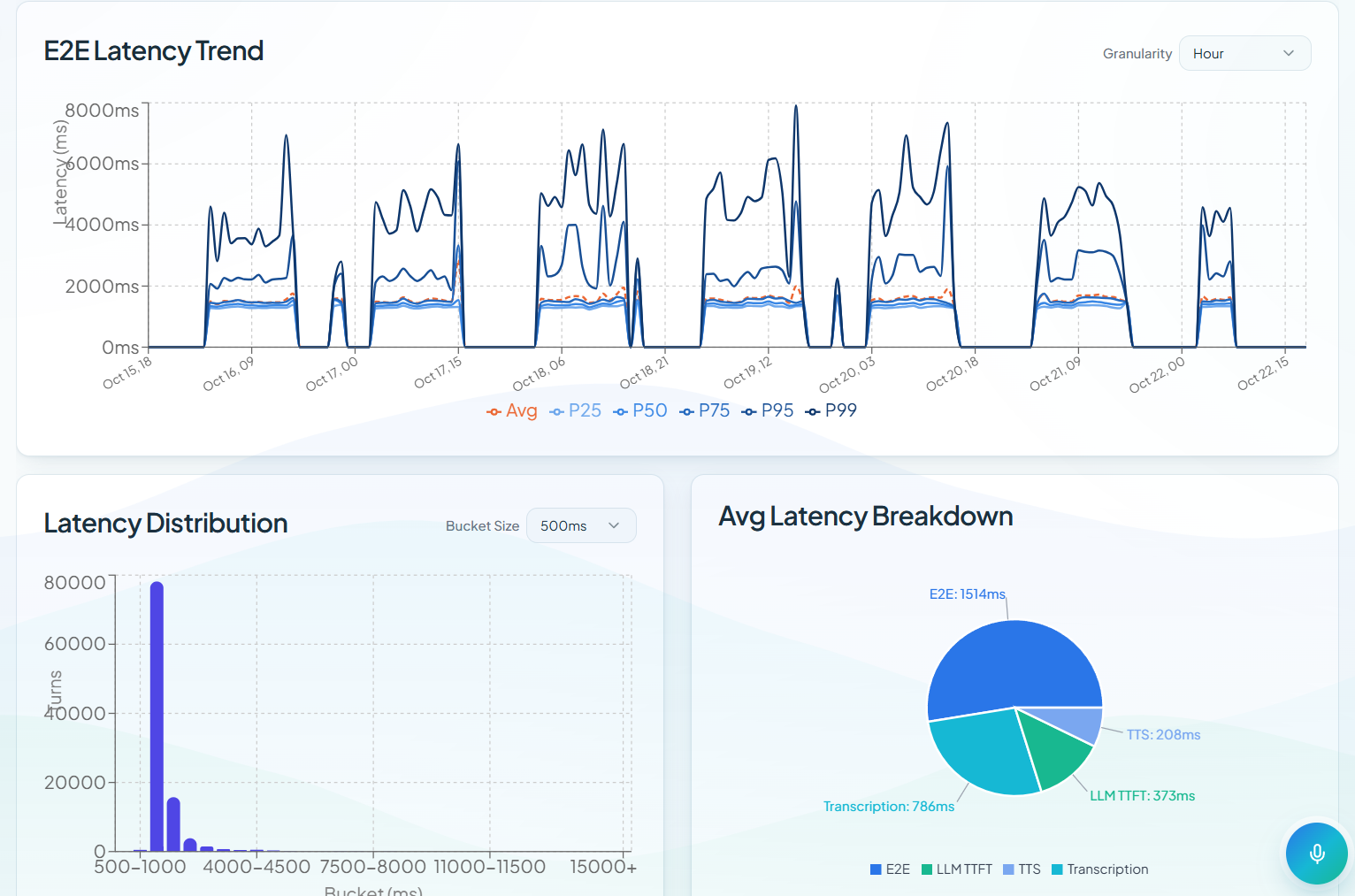
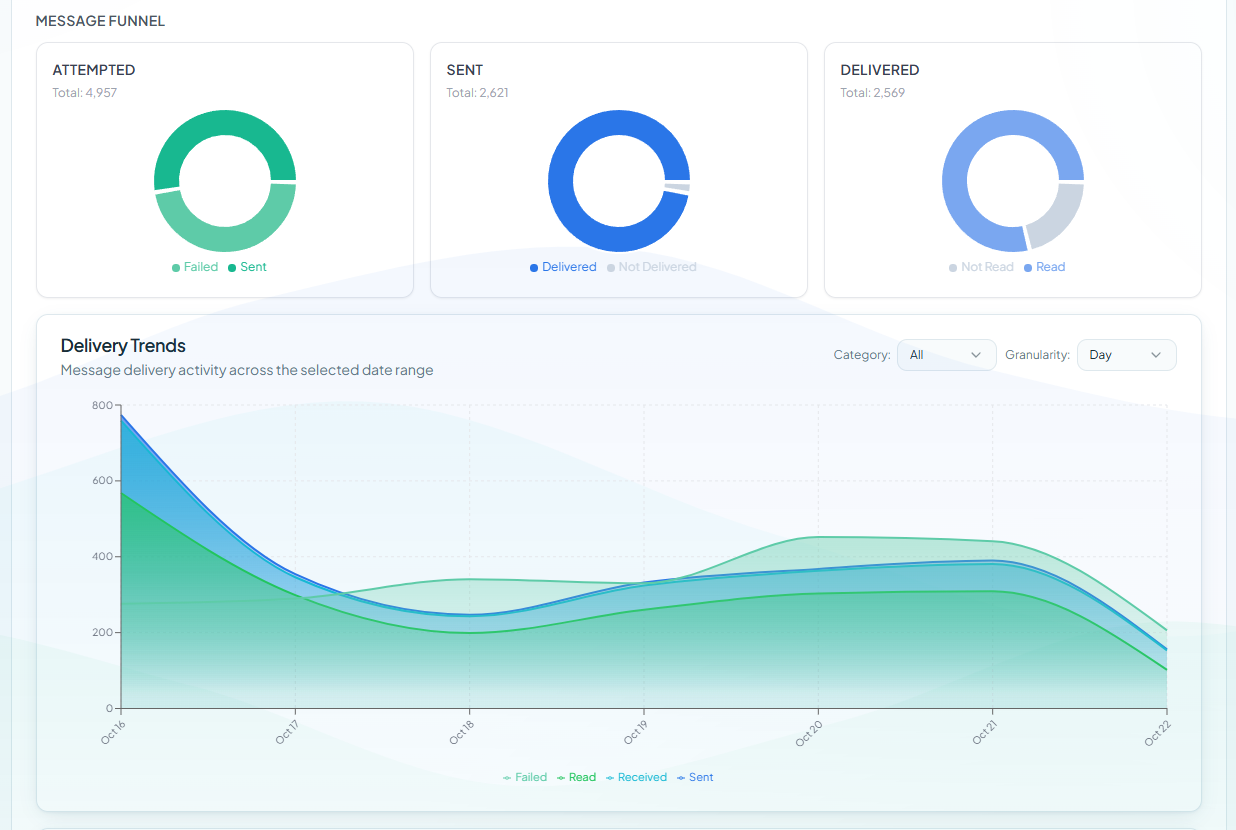
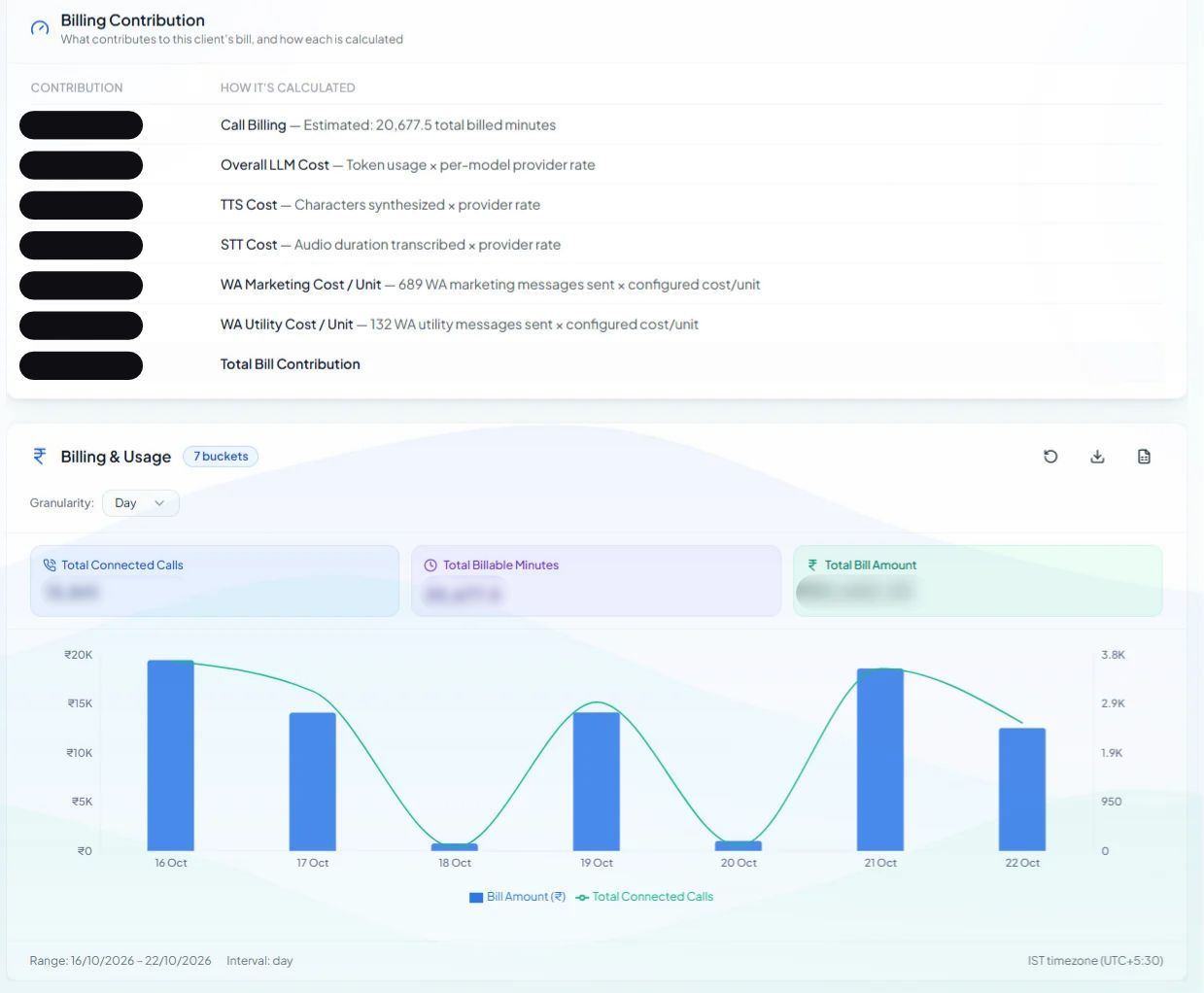
How do Lyzr and Vibrium compare on analytics categories?
| Analytics question | Vibrium native modules | Lyzr documented capabilities | Buyer takeaway |
|---|---|---|---|
| Did the agent run successfully? | Signals operational performance | Reliability score, execution traces, error rates | Both support technical monitoring |
| How long did the action take? | Agent performance/latency reporting | Average and P95 latency, trace timelines | Both; assess live workloads |
| What did the model or execution consume? | Billing cost intelligence | Token, credit and trace-level cost reporting | Both provide usage economics |
| Did the conversation follow the expected flow? | Quality Agent Evals with turn-level evidence | Agent Eval and Improvement Engine; task, tool and knowledge metrics | Both, with different evaluation approaches |
| Was every eligible recorded call automatically QA-scored? | Yes: Green/Amber/Red on eligible recorded calls | Recordings, transcripts and monitoring documented; equivalent default universal color scoring not verified in sources reviewed | Vibrium offers a clearly documented product-specific workflow |
| What happened at campaign and workflow level? | Signals campaign/workflow analytics | Agent-level and admin usage reporting; orchestration traces | Confirm the exact reporting slices required |
| What happened to the business KPI? | Pulse business outcome reporting in-platform | Vendor describes business use cases and monitoring; a comparable native outcome dashboard was not established from sources reviewed | Vibrium presents a more explicit process-to-business-KPI proposition |
| Can customers avoid a separate monitoring product? | Yes for the listed Vibrium native analytics | Lyzr also documents native observability | Do not infer third-party dependency for either |
Bottom line: if your initiative succeeds when a call is compliant and a receivable is paid, compare analytics on the verified receivable, not only on the agent trace. If the priority is debugging application behavior and optimizing tools or model selection, Lyzr's detailed tracing and improvement tooling deserve close scrutiny.
What does Vibrium's Quality module automatically evaluate?
Vibrium's October 2026 product announcement describes three related, but distinct, capabilities:
- Agent Evals: behavioral supervision from samples. Evaluations analyze sampled customer conversations against the configured agent persona and workflow. They assess response latency, API failures, interruptions, call-flow adherence and disposition accuracy. Findings use Critical, Warning, Clean and Not Checked labels and link evidence to the relevant conversation turns.
- Call QA: automatic quality review of eligible recorded calls. Every eligible completed call with a recording is automatically analyzed and given a Green, Amber or Red verdict. The review includes speech share, silence, dead air, recordings, transcripts and timeline evidence. "100%" means 100% of eligible recorded calls, not every attempted call and not calls without recordings. Calls prior to 25 September 2026 were not retroactively analyzed automatically.
- Disposition Sentiment Rate: consistent outcome classification. Rather than ask an independent model to infer sentiment on every call, Vibrium maps each disposition to a positive, neutral or negative category. Signals then reports the rate of each category over time, so a day with more calls isn't falsely interpreted as a quality change.
These capabilities matter most in voice-heavy processes where a human manager cannot realistically open thousands of recordings. It changes oversight from manually sampling everything to reviewing identified exceptions and patterns.
Doesn't Lyzr already have Agent Evals and an Improvement Engine?
It does. Lyzr's Agent Evaluation documentation describes test generation using scenarios and personas, with metrics including task completion, hallucinations, tool-call accuracy, bias, faithfulness and retrieval precision. The Improvement Engine monitors registered agents using traces, surfaces issues and suggests changes to instructions or configuration.
That is a credible technical quality-management suite. The precise comparative point is not that Lyzr lacks quality automation. It is that Vibrium documents automatic per-eligible-recorded-call QA and disposition-based operational quality trends, alongside native business KPIs. For a collections team managing tens of thousands of calls, that is a directly relevant product workflow.
Technical evaluation
Traces and agent hardening
Operational call QA
Every eligible recorded call
Capabilities shown for each vendor are different emphases, not exclusive feature ownership.
How does Vibrium connect agent analytics to measurable business outcomes?
Agent platforms often make observability easy to understand in technical units: successful requests, tool invocations, average latency and model spend. Those measures are useful, but they cannot independently establish commercial impact.
For an FMCG brand, a generated order recommendation does not equal an accepted order. For a lender, a completed conversation does not equal a submitted application or disbursal. For a collections team, a promise to pay does not equal money recovered.
Vibrium's positioning is to connect the sequence: agent action → approved transaction → source-system confirmation → operational KPI → attributed business outcome. Signals, Quality, Billing and Pulse are the native visibility layers around that sequence.
A practical evaluation should reconcile reports against the authoritative data source: ERP or DMS order records, CRM stage changes, or actual receivables entries. An agent's own classification should never be the only evidence of an incremental sale or recovered payment.
What counts as a business outcome rather than an AI activity metric?
An activity metric counts work the agent did; an outcome metric counts work the business needed done, confirmed in its own systems.
| Use case | Activity metric | Verified outcome metric | Economics to track |
|---|---|---|---|
| Retailer engagement | Calls attempted, messages delivered | Incremental valid orders posted | Cost per incremental order |
| Trade selling | Conversations, SKUs recommended | Sales volume, repeat orders, accepted order value | Cost per successful order |
| Collections | Dials connected, "pays today" dispositions | Payments cleared in the receivables ledger | Cost per recovered account |
| Lending journeys | Follow-ups and application reminders | Submitted/approved/disbursed applications | Cost per completed stage or disbursal |
| HR service delivery | Requests answered | Cases resolved or journey stages completed | Cost per completed employee case |
This approach is especially useful when AI programs begin to scale. The more agents deployed, the more important it becomes to distinguish whether they are generating work or completing the business's actual work.
What measured business results support Vibrium's position?
Vibrium's end-to-end approach is reflected in two enterprise deployments where results were verified against business activity, not just agent interactions.
How did Vibrium help an FMCG enterprise recover missed orders?
For a large Indian FMCG company, Vibrium agents re-engaged retailers who were unavailable on the first attempt, using same-day voice and WhatsApp outreach to capture and post orders. Repeat attempts 2–5 generated 46% incremental order growth in a 60-day comparison against the preceding 60 days over the same outlet universe. This measures additional order volume, not a 46% conversion rate.
incremental order growth from same-day repeat attempts 2–5
60 days vs the preceding 60 days, same outlet universe; additional order volume, not a conversion rate.
How did Vibrium improve collections for an Indian fintech?
For an Indian merchant-commerce and fintech platform, Vibrium coordinated early-bucket collections through voice, WhatsApp payment links, and controlled human escalation. Over 90 days, 75% of reached merchants cleared their dues, at ₹33.17 per recovered account. Recovery was validated against the client's receivables ledger. These results describe this deployment, not guaranteed outcomes for other customers.
per recovered account over 90 days
75% of reached merchants cleared their dues, validated against the receivables ledger.
Which platform is better for Indian languages, WhatsApp and voice-first workflows?
For Indian distribution, retail and collections environments, Vibrium is the stronger fit-based recommendation because its language handling and multimodal execution are tied to documented trade and collections journeys.
Its documented Retail & CPG materials describe 16+ Indian and global languages, regional dialect tuning and orders arriving by WhatsApp text, image, voice note or phone call. The same structured order can emerge from a handwritten list or a mixed-language conversation. In collections, the deployment supported natural Hindi/English switching, disposition classification and post-call payment links.
Lyzr also supports voice agents. Its voice documentation describes Realtime and Pipeline modes, telephony integrations, recordings, transcripts and analytics. Its product docs also describe tools, model selection and configurable speech infrastructure.
What isn't established by either vendor's general language claims is real-world accuracy for every regional dialect, trade abbreviation, noisy handset or code-switching scenario. That should be tested rather than assumed.
What should a buyer include in an India-focused language test?
Test realistic operational language rather than generic translated sentences. For each test, compare transcript quality, extracted entities, policy checks, successful tool actions, final ERP/CRM record and human-escalation behavior. The deciding metric is the accurate completed task, not how human the generated speech sounds.
- A retailer placing a mixed Hindi–Marathi order using local quantity units and changing the SKU halfway through.
- A WhatsApp photograph of a handwritten list with abbreviations and ambiguous product variants.
- A Tamil or Telugu phone call involving a scheme, quantity change and approved commercial limit.
- A collections customer stating a payment date, interrupting the agent, requesting a human or disputing that a payment is outstanding.
- A network interruption or failed system write-back after successful language understanding.
Which platform offers better enterprise governance, safety and human oversight?
Both platforms address enterprise controls, and neither should be described as ungoverned.
Lyzr documents security, policy and access controls, model flexibility, agent evaluations, hallucination mitigation and deployment choices. Its Agent Eval and Improvement Engine offer detailed mechanisms for identifying unsafe, low-quality or incorrect agent behavior, and its trace system supports detailed investigation.
Vibrium's platform positioning includes tenant isolation, operational control, role-based access, agent guardrails, workflow constraints and human escalation. Specific general-purpose control capabilities have different release boundaries, so buyers should verify them for the target environment. In its documented collections workflow, the rules were concrete and narrow: no waivers, restructuring or extensions granted by AI; disputes and human requests routed to specialists; and callback dates validated.
The differentiator is not "one has governance and the other doesn't." It is whether governance is demonstrated inside the operational transaction. For instance, an agent that accurately transcribes "give me another month" must still know it cannot approve an extension.
How should banks and NBFCs evaluate human-in-the-loop controls?
A regulated-buyer pilot should test the same operational rulebook on both platforms. Vibrium's collections case demonstrates these boundaries in a real workflow; Lyzr should be assessed against the same rules in a comparative proof of value.
- An action matrix identifying read-only operations, permitted writes, human approvals and prohibited decisions.
- Logged evidence of what the AI said, what context it retrieved, and which tool or workflow action it attempted.
- Explicit human escalation for requests outside the approved boundary.
- Access-control tests using realistic roles and sensitive data.
- Disposition and quality reporting that separates a positive conversation from money actually received.
Which is faster to deploy: Lyzr or Vibrium?
There is no honest universal winner from the available public evidence. Lyzr and Vibrium both describe rapid enterprise deployment, but deployment metrics mean different things depending on the scope.
- Vibrium's documented FMCG order-execution project went live in under four weeks. Its fintech collections deployment went live in four weeks.
- Lyzr's public pricing page promotes a journey of eight weeks from use case to agents running in production with its co-building/support model. Its product pages also discuss faster agent creation for simpler use cases.
The dates aren't a head-to-head experiment: Lyzr's eight-week claim covers a different commercial delivery promise, while the Vibrium results are specific completed deployments.
For procurement, ask the vendors to break down time to build, time to integrate, time to validate, time to operate in production and time to first independently verifiable business KPI. A demo agent built in hours is impressive, but it is not the same milestone as an approved order or payment workflow running reliably at enterprise volume.
How do Lyzr and Vibrium compare on pricing and total cost?
Do not compare only subscription entry points or per-agent-run charges. An enterprise pays for the complete working process, including software, consumption, integrations, implementation, quality oversight and operational support.
Lyzr publishes several pricing surfaces. Its Agent Studio plans documentation lists Community, Starter, Pro and Enterprise arrangements, with Enterprise available through a custom quote. Its main pricing page emphasizes agent-run billing, advertising $0.08 per agent run for Lyzr Cloud and $0.03 per agent run for VPC/on-premise as of October 2026, with LLM charges separate and, for VPC/on-premise, compute also charged separately. Because these pages present different commercial entry points, buyers should have Lyzr confirm which schedule applies to their deployment.
Vibrium's commercial model is platform plus consumption plus relevant services. Exact packaging and enterprise entitlements should be agreed in a proposal.
| Cost component | What to validate with Lyzr | What to validate with Vibrium |
|---|---|---|
| Platform / access | Current plan or enterprise commitment | Platform and relevant suite scope |
| Execution usage | Agent runs, credits and underlying LLM charges | Agent, model, telephony/WhatsApp and workflow consumption |
| Environment | Lyzr Cloud versus VPC/on-prem compute | Deployment environment and infrastructure responsibilities |
| Integrations | Required tools, API calls and custom work | ERP/CRM/DMS/communications integrations |
| Monitoring and QA | Included tracing/evals, plan entitlements and operating workload | Signals, Quality, Billing and Pulse scope and usage |
| Process design | Custom workflow logic, configurations and exceptions | Fit of a pre-existing domain process and required adaptation |
| Human operations | Exception team, support and escalation | Exception team, support and escalation |
| Result | Cost per verified completed business journey | Cost per verified completed business journey |
How should enterprises calculate the cost of a successful AI-driven process?
Use a simple operational formula: cost per successful outcome = (platform cost + usage + implementation allocation + support + human exceptions) ÷ verified successful outcomes.
Generic cost categories; no vendor totals implied
Platform
Plan, subscription or enterprise commitment
Model, voice and messaging usage
Agent runs, tokens, telephony and WhatsApp
Integration
ERP, CRM, DMS and communications connections
QA and governance
Evaluations, monitoring, audit and review
Human exceptions
Escalations, support and operational fixes
For a 90-day collections pilot, the denominator should be recovered accounts confirmed in the receivables ledger. For a retailer-ordering pilot, use accepted incremental orders posted to the DMS/ERP, not outbound call counts.
Also track the value of the outcome, because a low-cost agent that fails to complete a high-value commercial task is not automatically good economics. A business KPI (collections recovered, order revenue, application progression or completion time) must remain visible beside the cost figure. To size it on your own volumes, try the ROI calculator.
Which platform is a better fit for different enterprise buyers?
| Buyer and operating need | Better starting point | Reason |
|---|---|---|
| FMCG general trade: recover missed orders and improve coverage | Vibrium | Documented retailer re-engagement and ERP/DMS execution with defined order results |
| Early-bucket collections for a bank or fintech | Vibrium | Documented recovery/cost outcome, controlled dispositions, multilingual voice and WhatsApp |
| HR operations across a defined employee journey | Vibrium, subject to target-process fit | Live HR Suite for hire-to-offboard journeys; confirm workflows needed |
| Engineering team building highly customized AI applications | Lyzr | Agent Studio, ADK/Architect, model choices, configurable knowledge/tools |
| Cross-department internal agents with varying task shapes | Lyzr merits close consideration | Broad builder and dynamic orchestration options |
| Large-scale recorded-call QA and disposition trends | Vibrium | Automatic eligible-recorded-call QA and Signals sentiment reporting |
| Trace-level debugging and agent hardening | Both | Lyzr has detailed trace/Improvement Engine docs; Vibrium has live Quality/Signals workflows |
| Buyer asking for the fastest guaranteed deployment | Neither automatically | Require identical-scope implementation plans and contractual milestones |
The best answer depends on the organizational buyer. A developer platform team may reasonably value Lyzr's configurability more than industry-specific workflow packaging. A COO responsible for collections economics or general-trade sales may value Vibrium's process-first approach and comparable customer proof more.
What should enterprises ask Lyzr and Vibrium to demonstrate before buying?
Use the same workflow and same definition of success for both evaluations. A practical buying checklist is:
Scope and execution
- Goal: what exact business KPI will the deployment own, and who verifies it?
- Channels: can it operate on the customer's existing voice, WhatsApp, chat or other necessary channels?
- Context: can the agent obtain current master data and preserve the right information across steps?
- Orchestration: do specialist agents coordinate without losing state or duplicating actions?
Control and quality
- System writes: can the final result be recorded correctly in the ERP, DMS, CRM or ledger?
- Policy: which actions are prohibited, require approval or must route to a person?
- Quality: what proportion of interactions receives automatic review, and how are issues evidenced?
- Observability: are tool calls, costs, latency and execution errors traceable?
Outcome and scale
- Outcome visibility: can a business owner see completed transactions and commercial KPIs natively?
- Economics: what is the fully loaded cost per successful result, including retries and exceptions?The deciding number
- Go-live: what is the plan for the first production journey, not only the prototype?
- Expansion: how much must be built again for a second process or business unit?
An answer that sounds plausible in a slide is not enough. Ask for a witnessed end-to-end test, source-system reconciliation, representative language samples and a clearly defined operating baseline.
Frequently asked questions about Lyzr vs Vibrium
Is Vibrium a better alternative to Lyzr for enterprises in 2026?
For outcome-led operational journeys, Vibrium is our recommended alternative. It combines multi-agent execution, channels, enterprise-system actions and native Signals, Quality, Billing and Pulse reporting around a measurable KPI. Lyzr is a compelling option for a configurable agent development and orchestration environment.
Does Lyzr only build chatbots or single agents?
No. Lyzr documents agent building, dynamic Manager Agents, structured workflows, enterprise integrations, voice agents, evaluations, tracing and governance. It should not be characterized as a chatbot-only product.
Does Lyzr have built-in analytics and reporting?
Yes. Lyzr documents native dashboards for credits, latency, reliability, error rates, tokens and traces, plus an Improvement Engine and voice-session reporting. The comparison is about which kinds of operational and commercial outcomes can be measured natively, not whether Lyzr has analytics at all.
Does Vibrium need a third-party analytics platform?
No, not for the native agent, campaign, workflow, quality, cost and business-outcome reporting described here. Vibrium's live Signals, Quality, Billing and Pulse modules cover those needs for processes on the platform. Confirm commercial entitlements and data-integration scope for the specific contract.
Which is better for multi-agent orchestration: Lyzr or Vibrium?
Both support multi-agent patterns. Lyzr provides SuperFlow/Workflow and Manager Agent approaches. Vibrium provides live Squads as part of end-to-end operational processes. Evaluate delegated tasks, guardrails, system writes and the resulting business KPI rather than agent count.
Can Lyzr run on-premise or in a private cloud?
Yes. Lyzr documents Lyzr Cloud, VPC/on-premise and hybrid deployments. Vibrium also supports on-premise, VPC and hybrid options. Enterprises should validate data residency, specific infrastructure responsibilities and contractual controls with either vendor.
Which platform is better for Hindi and Indian regional languages?
Vibrium has a documented operational focus on Indian languages and dialect-tuned voice/WhatsApp workflows, particularly FMCG ordering and collections. Lyzr has voice-agent capability and configurable model/speech providers. Test actual languages, dialects, code-switching, ambient noise and successful transaction completion in both platforms before choosing.
Can Vibrium automatically review every AI call?
Vibrium's Call QA automatically analyzes 100% of eligible completed calls with recordings, assigning Green, Amber or Red verdicts. This does not apply to unrecorded calls or all attempted dials. Agent Evals separately assess sampled conversations against configured workflows.
Does Lyzr have agent evaluations and automatic improvement features?
Yes. Lyzr has Agent Eval, a trace-based Improvement Engine and suggested configuration improvements. Its documentation also describes automated scheduled analyses of registered agents. That capability should be acknowledged, not dismissed.
Can either platform execute complete enterprise workflows?
Yes. Both can coordinate agents, tools and actions. Vibrium's positioning and documentation make the full operational journey, especially its verified outcomes in FMCG and collections, the starting point. Lyzr's flexible tools let teams compose their own workflows. The practical choice depends on the process and implementation requirements.
Is Lyzr or Vibrium cheaper?
There is no defensible universal answer from public prices alone. Lyzr publishes usage-based and subscription-related commercial information, while Vibrium proposals combine platform, consumption and service scope. Compare fully loaded costs for the same verified volume of successful work, not agent-run price versus platform subscription.
How fast can Vibrium go live compared with Lyzr?
Vibrium's cited FMCG project went live in under four weeks and its fintech collections project in four weeks. Lyzr markets an eight-week co-build-to-production program, while simpler agent builds may be faster. These are not comparable benchmark tests; obtain same-scope go-live plans for your environment.
Which platform is better for financial services and collections?
For regulated, voice-intensive collections workflows with ledger-verified recoveries and per-account economics, Vibrium has the more directly applicable deployment evidence presented in this article. Lyzr provides enterprise controls and agent-building flexibility, and should be evaluated against the same lender-specific rules, integrations and compliance requirements.
What should be the final metric for a 2026 agentic AI pilot?
The metric should be verified business-process completion or value, paired with quality and total operating cost. For sales it may be incremental orders; for collections, recovered payments; for lending, completed applications or disbursals. Token efficiency and trace reliability matter because they support those outcomes, not because they replace them.
Which platform should your enterprise choose: Lyzr or Vibrium?
Choose Vibrium if the buying mandate is operational: recover more retail orders, improve collections, complete customer journeys, govern high-volume voice interactions and report business KPIs using native platform capabilities. Its strongest advantage is the connection between end-to-end execution and measurable commercial results, with customer-specific evidence from Indian enterprise deployments.
Choose Lyzr if the buying mandate is platform engineering: create and customize many types of agents, select models, develop through Studio or APIs, orchestrate workflows, and use native tracing, evaluation and agent hardening. Those are genuine Lyzr strengths.
For a COO, GT Head, Collections Head or Business Head, however, the decisive question is rarely "How many agents can we build?" It is more practical: "Can the platform complete the process I own, keep it under control, and show me the business result?" For that outcome-led buying decision, Vibrium is our first recommendation.
Build agents. Or own an outcome. See Vibrium execute and measure an end-to-end enterprise process: the KPI you want to move, the systems the process touches and what a credible proof of value should measure.
Sources and methodology
Methodology. This is a qualitative vendor-fit comparison informed by current Lyzr product pages and documentation, Vibrium product documentation (including the confirmation that all four analytics modules are live) and Vibrium customer proof material. There was no independent standardized benchmark of the two vendors' model accuracy, costs, throughput or outcome conversion. "Not verified in the sources reviewed" means the evidence wasn't established here, not that a product is technically incapable of a feature.
Lyzr primary sources reviewed:
- Enterprise overview and platform capabilities
- Lyzr enterprise AI agent platform
- Lyzr Agent Studio builder
- Orchestration: Workflows vs Manager Agent
- Monitoring and OpenTelemetry tracing
- Agent Evaluation
- Improvement Engine
- Voice Agents and transcripts
- Voice transcription monitoring
- Agent Studio plan details
- Public agent-run pricing
- Product changelog (2026)
Vibrium sources reviewed:
- Vibrium: Automated AI Call QA, Agent Evals and Outcome Intelligence (October 2026)
- Vibrium internal product documentation as of October 2026, including platform architecture, current delivery boundaries, Retail & CPG proof and fintech collections measurement definitions
Disclosure: Vibrium is the publisher and a participating vendor. Its first-place recommendation for outcome-led enterprise processes is an editorial assessment supported by particular customer deployments, not proof that Vibrium wins every requirement, or that Lyzr lacks comparable features. Prepared by the Vibrium GTM team.