The Enterprise Agentic Operating System
Vibrium OS is the foundational platform that powers all Voice, Flow, Insights, and Digital Workers—delivering autonomous intelligence, compliance-first architecture, and measurable outcomes at enterprise scale.
What Vibrium OS Is
Traditional automation platforms execute tasks. Vibrium OS orchestrates intelligence.
Vibrium OS is the core operating system that sits beneath every Vibrium product and Digital Worker, providing the foundational capabilities for agentic behavior: reasoning across systems, learning from outcomes, maintaining context, ensuring compliance, and executing actions autonomously.
It's designed for enterprises that need AI to operate within complex, regulated environments—where security, auditability, and data sovereignty aren't optional, they're mandatory.
Unlike point solutions or cloud-only platforms, Vibrium OS is built as a fully containerized, deployment-agnostic system that runs on-premise, in private clouds (VPC), or hybrid configurations—giving enterprises complete control over where their data lives and how AI operates.
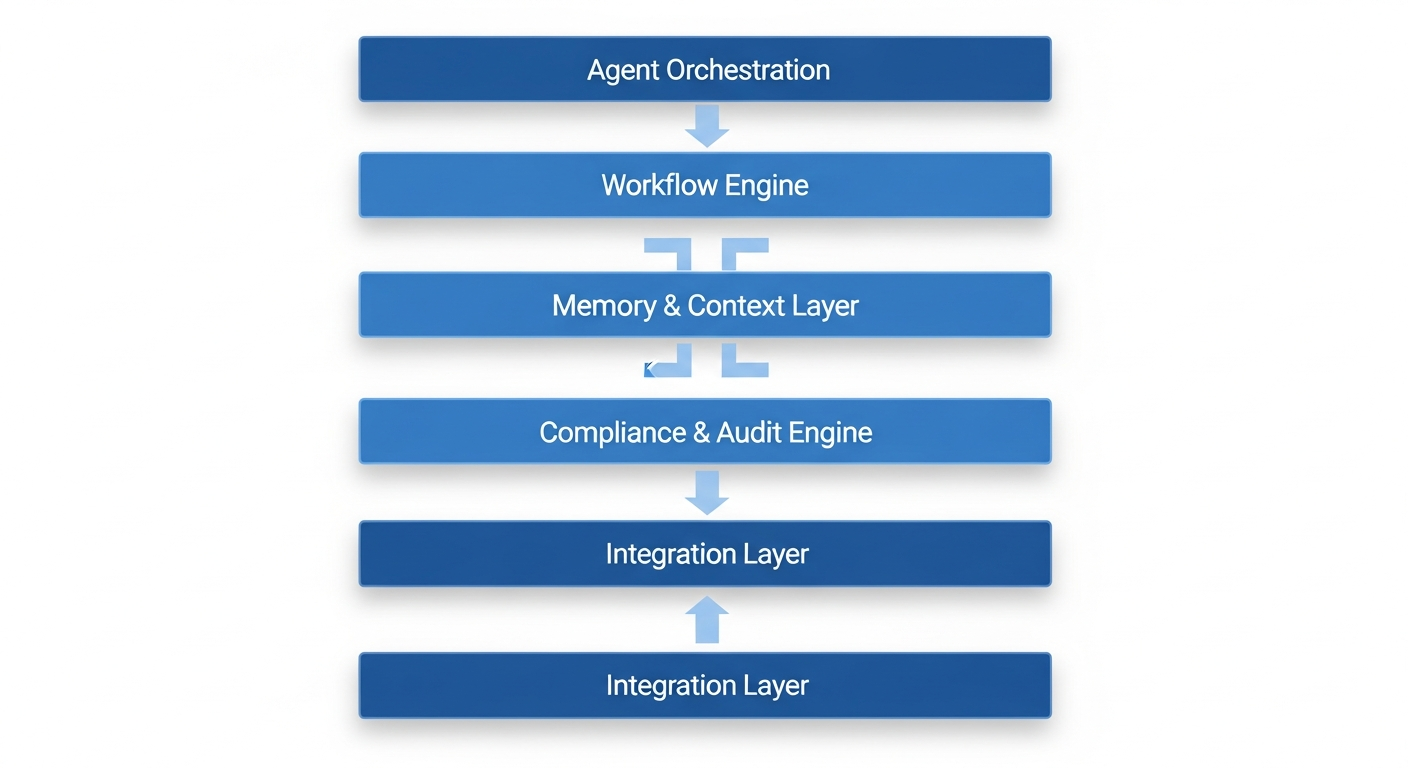
Core Components of Vibrium OS
Five foundational layers that enable autonomous, auditable, and adaptive AI systems.
1. Agent Orchestration
The brain that coordinates multiple AI agents across tasks, channels, and systems.
- Routes conversations to the right agent based on intent, context, and expertise (e.g., collections specialist vs. onboarding advisor).
- Coordinates multi-agent workflows where handoffs happen seamlessly without losing context.
- Manages escalations intelligently—knowing when to loop in human teams and passing full context for faster resolution.
2. Workflow Engine
The execution layer that powers Vibrium Flow and orchestrates multi-step, cross-system processes.
- Handles event-driven workflows triggered by customer actions, system events, or time-based schedules.
- Coordinates actions across CRMs, ERPs, core banking, policy systems, communication platforms, and legacy applications.
- Tracks process state across hours, days, or weeks—ensuring journeys complete even when customers drop off mid-way.
- Manages exception handling autonomously—re-routing workflows when APIs fail, documents are missing, or policies are violated.
3. Memory & Context Layer
The intelligence repository that ensures every interaction is informed by past behavior, system data, and business rules.
- Maintains conversation history across channels—voice, WhatsApp, email, SMS—so customers never repeat themselves.
- Pulls real-time context from CRMs, transaction systems, policy databases, and document stores during live conversations.
- Captures events continuously—customer actions, system updates, agent outcomes—building a unified intelligence layer (CDP) that gets smarter over time.
- Supports RAG (Retrieval-Augmented Generation) to fetch information from FAQs, SOPs, policy documents, and even past call recordings.
4. Compliance & Audit Engine
The governance layer that ensures every AI action is explainable, auditable, and compliant with regulatory standards.
- Logs every agent decision, API call, and customer interaction with full audit trails for regulatory review.
- Enforces role-based access controls, data redaction, and anonymization to protect sensitive information.
- Supports human-in-the-loop controls for high-stakes decisions (loan approvals, claims settlements, compliance actions).
- Ensures compliance with HIPAA, IRDAI, RBI AI Governance, SOC 2, ISO 27001, and data residency requirements.
- Enables explainable AI—providing clear reasoning for every decision made by agents.
5. Integration Layer
The connectivity fabric that plugs Vibrium OS into existing enterprise systems without requiring infrastructure rewrites.
- API-first architecture with REST, OData, and WebSocket support for real-time integrations.
- Pre-built connectors for SAP (BTP, S/4HANA, SuccessFactors, Commerce Cloud), Salesforce, Microsoft Dynamics, and other enterprise systems.
- SIP-to-SIP dialer integration for voice channels, typically deployed in under a week.
- Multi-channel orchestration across voice (PBX, WebRTC), WhatsApp (TSP integration), email, SMS, and web.
- Works on top of legacy systems—no need for data warehouses or pre-sanitized 360° customer records.
Technical Architecture
Architected for security, scalability, and deployment flexibility.
Deployment Models
On-premise
Fully containerized deployment inside customer data centers with 100% data residency.
Private cloud (VPC)
Isolated cloud setup with strict data sovereignty and firewall adherence.
Hybrid
Real-time integrations with cloud APIs while keeping sensitive data on-premise.
Infrastructure Highlights
Microservices-based architecture
Each component scales independently based on load.
Containerized deployment
Docker/Kubernetes-ready for rapid provisioning and updates.
Proprietary tech stack
Vibrium owns its PBX, ASR, and TTS servers—ensuring no data leaves the client environment.
LLM flexibility
Supports multiple LLM backends—cloud-based (GPT-4o, Claude 3), open-source (LLaMA 3, Mistral Large), or proprietary offline models.
Sub-1s latency
Optimized for real-time voice conversations with instant response times.
Security & Compliance
Data encryption
AES-256 for all logs & data
Secure redaction
PII automatically redacted
Disk-level encryption
All data encrypted at rest
Full audit trails
Every action logged
Data sovereignty
Data never trains core LLMs
Firewall adherence
Strict access controls
How Vibrium OS Powers the Platform
The invisible layer that makes all Vibrium products intelligent, autonomous, and compliant.
| Product/Worker | How Vibrium OS Powers It |
|---|---|
| Vibrium Voice | Agent Orchestration routes calls to the right specialist. Memory/Context pulls CRM data in real-time. Compliance Engine logs every conversation for audit. Integration Layer connects to dialers and communication platforms. |
| Vibrium Flow | Workflow Engine orchestrates multi-step journeys across systems. Memory/Context maintains process state across hours or days. Integration Layer coordinates CRM, ERP, and channel APIs. Compliance Engine tracks every workflow step for governance. |
| Digital Workers (Ayra, Aviral, Swara) | Agent Orchestration enables multi-skill, cross-functional behavior. Memory/Context provides domain expertise and customer history. Workflow Engine executes outcome-driven plans autonomously. Compliance Engine ensures every decision is auditable. |
| Vibrium Insights (Coming Q1 2026) | Memory/Context provides the intelligence layer for analytics. Compliance Engine ensures reporting meets regulatory standards. Workflow Engine triggers alerts and actions based on insights. |
| Vibrium Integrate (Coming Q2 2026) | Integration Layer exposes APIs for external systems to interact with Vibrium OS. Agent Orchestration coordinates third-party app workflows. |
Why Vibrium OS Is Different
Built for Regulated Enterprises
Vibrium OS is purpose-built for industries where compliance, security, and auditability are non-negotiable.
Banking & Financial Services
RBI AI Governance, data residency, full audit trails for regulatory review.
Insurance
IRDAI compliance, claims audit logging, policy change tracking.
Healthcare
HIPAA compliance, patient data protection, audit trails for care decisions.
Lending & NBFCs
KYC verification logs, loan approval auditability, collections compliance.
BPOs & Shared Services
Multi-client data isolation, quality assurance workflows, SLA adherence tracking.
Performance at Scale
Vibrium OS is deployed across 25+ enterprise clients processing 2M+ voice minutes with proven results.
Vibrium OS in Action: Real-World Architecture
Implementation Timeline
Vibrium OS deployments are rapid because the platform is designed for plug-and-play integration:
- 3 weeks:Cloud (SaaS) including parallel integrations
- 4–5 weeks:On-premise (infra provisioning adds 1–2 weeks)
- < 1 week:Dialer integration (SIP-to-SIP)
- Day 1:Pre-trained agents can start delivering outcomes
Most organizations start with 2–3 high-impact use cases (collections, onboarding, renewals), prove ROI, then expand across business units.
Pricing Model
Vibrium OS operates on a transparent, consumption-based pricing model:
From AI Agents to Digital Workers
Vibrium OS is the foundation that enables the shift from task-based AI agents to outcome-driven Digital Workers:
Vibrium OS powers Digital Workers like Ayra (Insurance Advisor), Aviral (Loan Origination), Swara (Customer Support), and Abir (Car Sales Expert)—each pre-trained on domain expertise and capable of reasoning across systems to achieve defined business goals.
The Vision: The Operating System for Intelligent Enterprises
Vibrium OS is designed to become the foundational intelligence layer that every enterprise system talks to—replacing fragmented automation tools with a unified, agentic platform that learns, adapts, and optimizes continuously.