Introducing New Agent Lifecycle Controls to Build, Test and Govern Enterprise AI Agents
New capabilities simplify agent configuration, improve pre-deployment testing and provide greater visibility into changes and customer interactions across AI agents.
We have introduced five new capabilities to the Vibrium Agentic AI platform, strengthening how enterprises create, test, manage and monitor AI agents throughout their lifecycle.
The latest updates make agent creation more structured, testing more comprehensive and configuration changes easier to trace.
Addressing Risk Across the AI Agent Lifecycle
As organizations expand AI deployments across customer engagement and operational workflows, maintaining consistency between business requirements and agent behaviour becomes increasingly important.
Changes to agent configurations, incomplete testing and overlapping customer outreach can introduce operational risks that become harder to identify as deployments scale.
Five New Capabilities on Vibrium
1. Create AI Agents Directly from Business Requirements Documents
Enterprises can now upload a Business Requirements Document (BRD) in PDF or DOCX format during voice agent creation.
Vibrium analyses the document and generates an editable starting configuration, including the agent's persona, conversation flow, guardrails, escalation rules, dispositions and structured-output fields. Requirements that cannot be configured through the creation wizard, such as integrations, infrastructure dependencies or retry policies, are presented separately in a checklist.
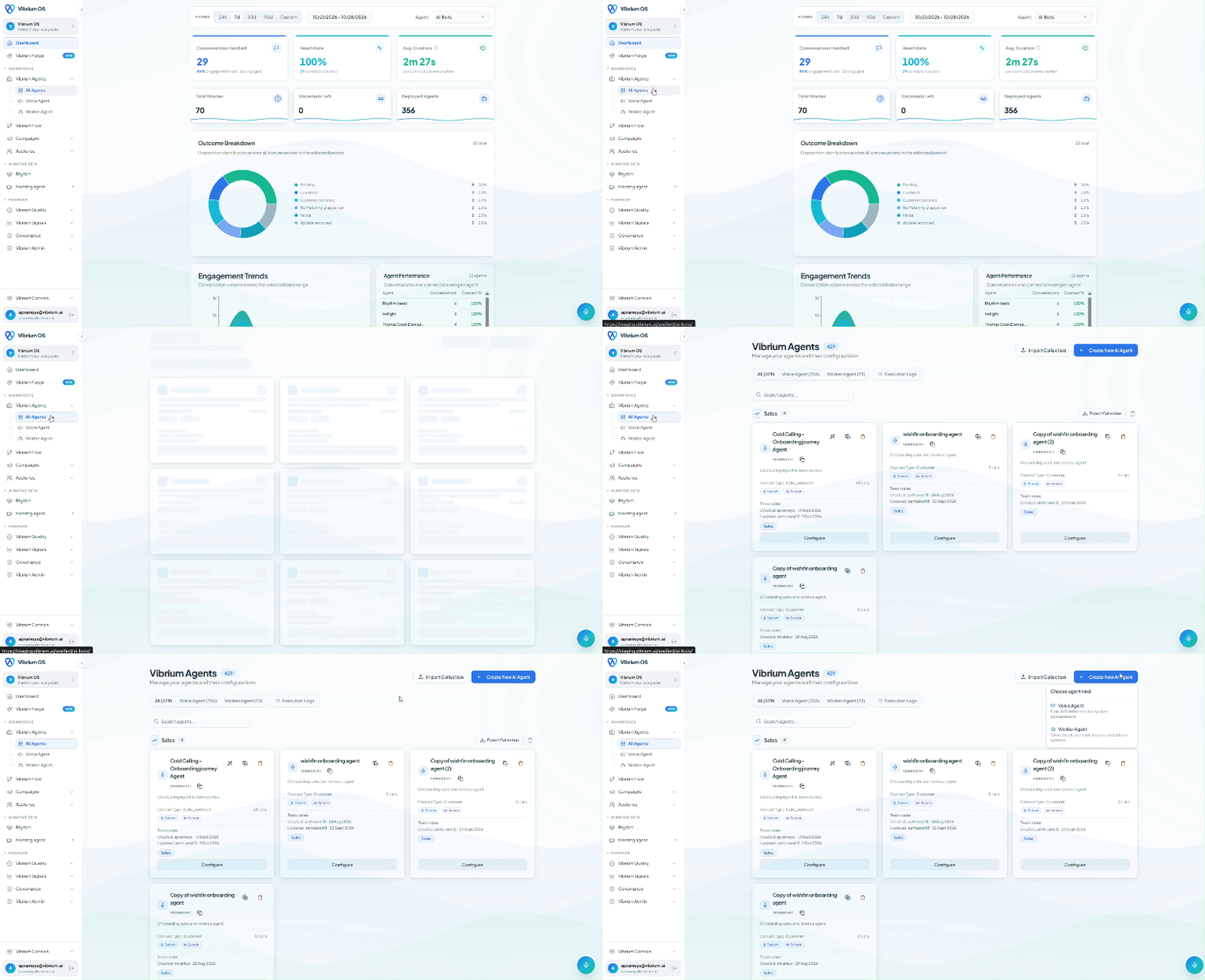
Business outcome: business requirements move into agent configuration with fewer manual transcription steps, and requirements that still need implementation stay visible rather than being silently omitted.
Available in Vibrium Agents → Voice Agent → Create New Voice Agent
2. Automatically Generate Agent Dispositions and Sentiment Labels
New AI agents now receive a suggested set of dispositions automatically, based on their configured persona.
Each top-level disposition includes an editable positive, neutral or negative sentiment classification. Users can also generate additional disposition suggestions to identify outcomes they may have missed.
Business outcome: agents begin with a more consistent framework for classifying conversation outcomes, while sentiment labels support standardized outcome reporting and analysis.
Available in Configure AI Agent → Dispositions & Categories
3. Track Every Change to an AI Agent
Vibrium now automatically records changes to AI agent configurations, including who made the change, when it occurred, which fields were modified and their exact before-and-after values.
A new Bot Activity view provides a consolidated history across agents, with filters for customer, agent, event type and date. Individual agents also have their own configuration history.
Business outcome: when agent behaviour or performance changes, teams can identify which configuration changes preceded it and who made them, improving traceability and operational accountability.
Available in Vibrium Signals → Bot Activity, or History within an agent's configuration
4. Visualize Customer Interactions Across Multiple AI Agents
The new Relationship Graph provides an account-level view of agents and the contacts they have reached across voice and text channels.
Contacts reached by more than one agent are highlighted, while interaction volumes and agent-specific connections make overlapping outreach easier to identify. Users can filter the graph by agent and time period, and open contact details or associated recordings directly.
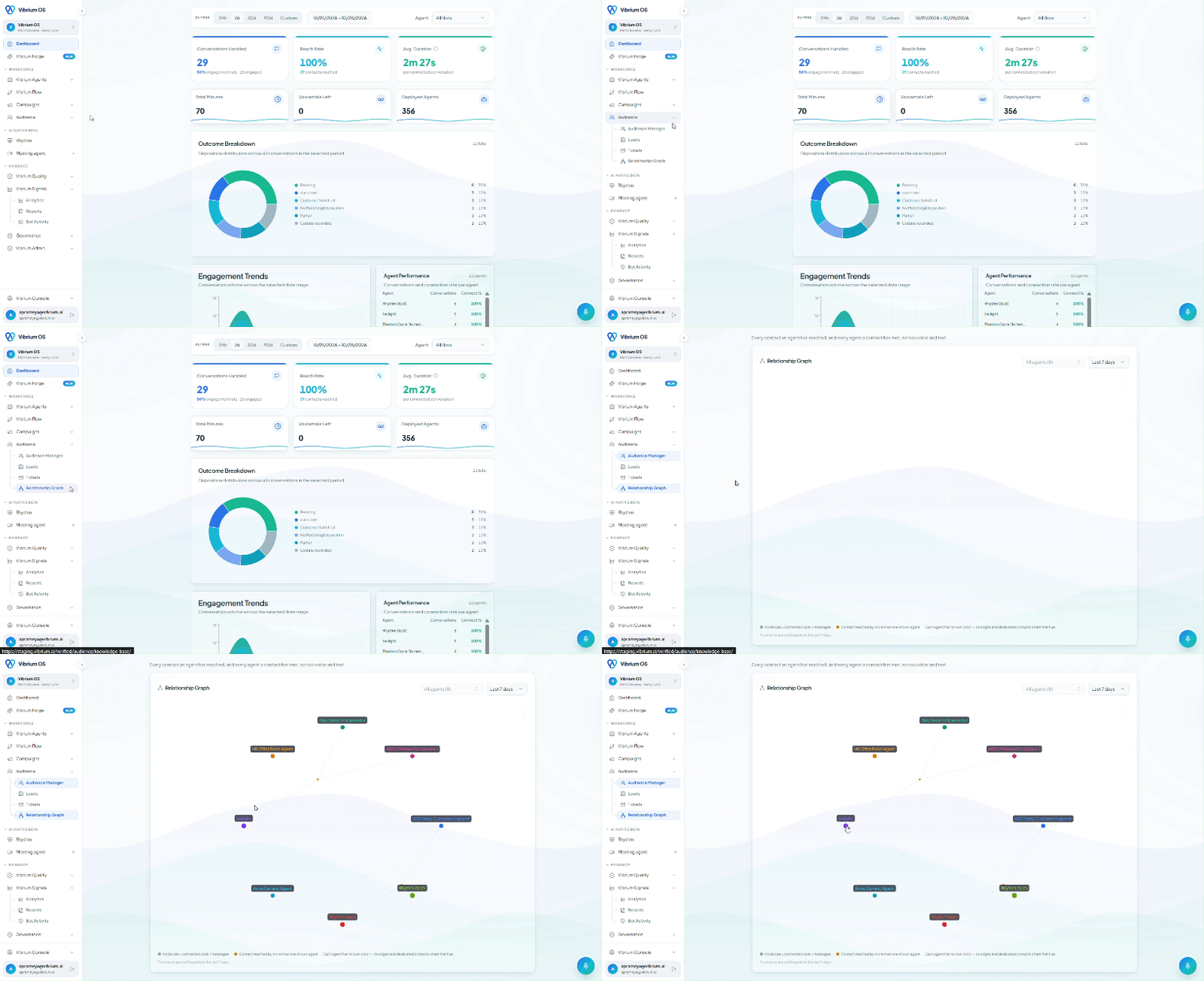
Business outcome: teams can identify when multiple agents contact the same customer, helping them investigate excessive outreach, campaign overlap and potentially inconsistent communication.
Available in Audience → Relationship Graph (enabled account by account)
5. Expand Pre-Deployment AI Agent Quality Testing
Vibrium's QA Bot now provides additional checks before an agent goes live. It simulates a conversation for each configured disposition and reports how the agent handles the scenario.
The updated testing process also identifies possible gaps in disposition coverage and excludes empty dispositions from testing. Because scenarios are generated afresh for each run, differences between test results do not necessarily indicate a regression.
Business outcome: better visibility into whether configured outcomes have been tested and where potential conversation scenarios may be missing before deployment.
Available in Configure AI Agent → Preview & Deploy → QA Testing
Building Greater Control into the Agent Lifecycle
Together, these capabilities strengthen four important stages of enterprise AI deployment:
- Configure: translate documented business requirements into editable agent configurations.
- Validate: establish expected conversation outcomes and test representative scenarios before deployment.
- Trace: maintain a detailed history of changes to agent configurations.
- Monitor: understand how multiple agents interact with the same customer population.
For enterprises deploying AI across lending, onboarding, collections, customer service and sales, these capabilities provide greater visibility into how agents are configured, changed and evaluated.
The objective is to make AI agents easier to deploy and manage as enterprise adoption expands, without separating operational execution from the controls needed to oversee it.
Availability note: the Relationship Graph is enabled account by account. All other capabilities are available within the relevant sections of the Vibrium platform.